
A robot vacuum moving smoothly from hard floor onto a low-pile area rug in an Australian home
Robot vacuums work reliably on low-pile and medium-pile rugs. High-pile and shag rugs are harder — some robots stall, some avoid them entirely. The three features that determine how well a robot handles mixed-floor homes are carpet boost, automatic mop lifting, and app-based no-go zones.
Do Robot Vacuums Work on Rugs?
High-pile and shag rugs create genuine problems: the added height can catch the bumper, trigger false obstacle detections, or cause the wheels to lose traction. Some robots stop and return to base. If your home has rugs thicker than 15–20mm, check the robot's stated maximum pile height before buying.
For combined vacuum-and-mop robots, there is a second concern: a robot without automatic mop lifting drags a damp pad across every rug it crosses, which deposits moisture into the fibres over time. Robots with mop lifting handle this automatically.
Fluffy and thick rugs above 20mm are the practical limit for most current robot vacuums. A robot that handles a 12mm low-pile rug well can still get stuck on a 25mm shag. For homes with thick or fluffy rugs, the safer approach is to confirm the robot's maximum pile clearance against the rug's actual height, then set a no-go zone for any rug that exceeds it.
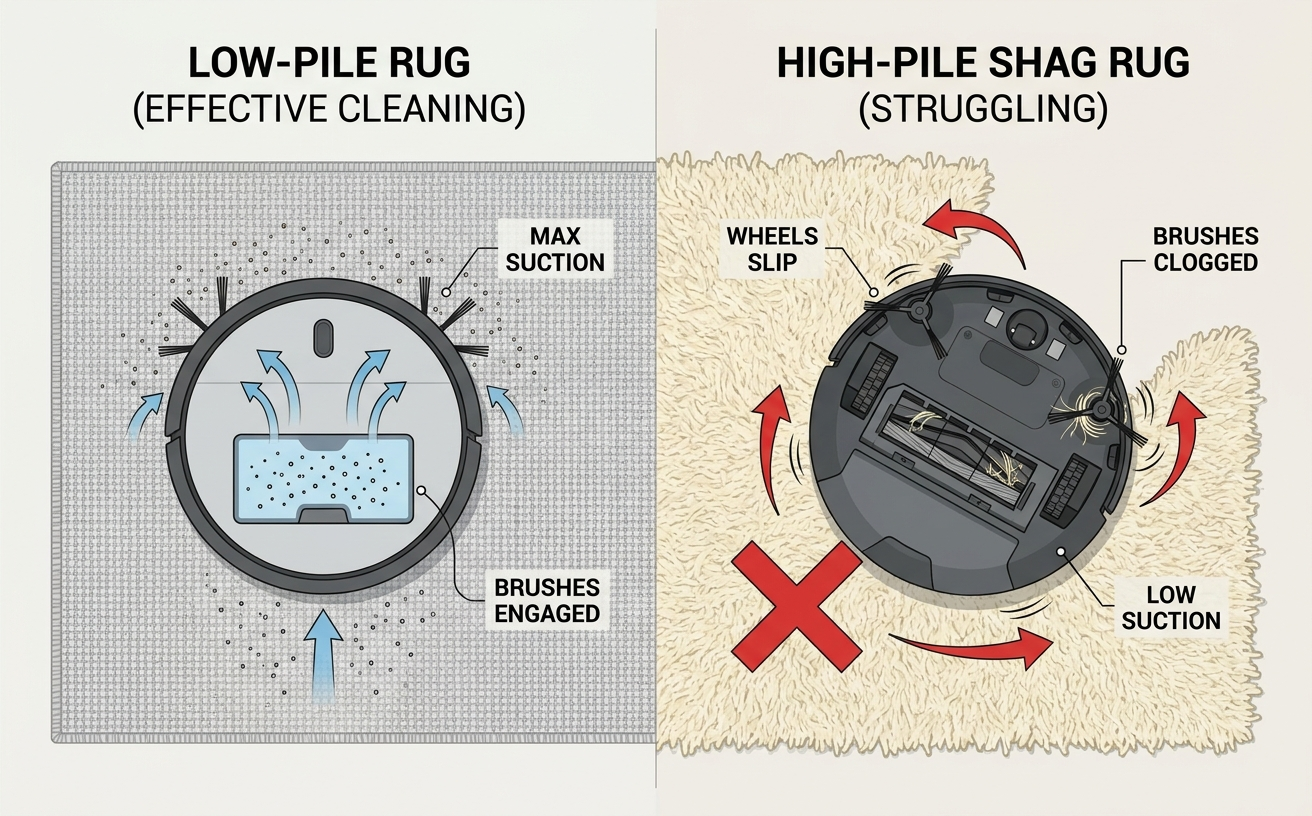
Low-pile rugs suit robot vacuums well; high-pile rugs can challenge navigation and suction
What Is Carpet Boost?
Carpet boost detects when the robot crosses onto a textile surface and automatically raises suction. On hard floors, the robot runs at a moderate level to preserve battery; on rugs, it increases airflow to reach embedded dust, pet hair, and fine debris inside the weave.
The Narwal Flow robot vacuum implements this as CarpetFocus Technology: when carpet is detected, it forcefully lowers the brush cover to create a sealed high-pressure airflow zone, delivering a 182% increase in suction and a 2x pickup rate versus the industry average. At 22,000Pa base suction, that margin is substantial.
How Mop Lifting Works on Rugs
For any robot that vacuums and mops in a single pass, automatic mop lifting is the only way to avoid wetting rugs. Without it, the robot drags a damp pad across the surface every time it crosses from hard floor to rug. A lift height of at least 10–12mm clears most low-pile and medium-pile surfaces without contact.
The Narwal Flow auto-lifts its track mop to 12mm on carpet detection, vacuums in boost mode, then lowers the mop again on hard flooring. The Narwal Freo X10 Pro robot vacuum uses the same 12mm lift and adds ultrasonic sensors that detect carpet type, with four cleaning modes selectable via the Narwal app — tight carpet (floor mat), low-pile rug, high-pile carpet up to 7mm, and bath mat at 12mm.
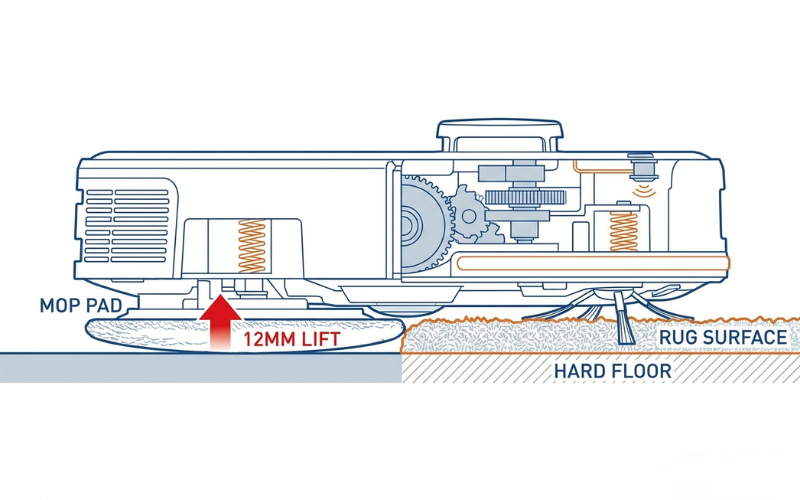
Automatic 12mm mop lift prevents moisture transfer onto rug fibres
Handling Tassels and Lightweight Rugs
Tassels are the most common cause of robot vacuum failure on rugs. The brush roll or side brushes catch a fringe strand, jam the mechanism, and trigger an error. Tuck tassels under the rug edge, or draw a no-go zone around the fringe area in the robot's app.
Lightweight rugs — bath mats, thin cotton runners, flat-weave mats — tend to bunch up as the robot passes over them. Suction creates enough drag to shift the rug edge. A non-slip pad underneath fixes most of this; double-sided rug tape works well on smooth tile.
Rugs with thick rubber-backed edges or raised decorative borders can create a transition the robot cannot clear. Most robots handle steps up to 15–20mm; anything higher may need a ramp strip to reduce the height. Delicate fibre rugs need extra care: see our guide to cleaning a wool rug for fibre-safe handling beyond what a robot vacuum can do.
| Rug Type | Pile Height | Robot Vacuum Compatibility | Key Consideration |
|---|---|---|---|
| Low-pile / flat weave | 0–5mm | Excellent | Standard mode works; carpet boost improves results |
| Medium-pile | 5–12mm | Good | Carpet boost recommended; check mop lift height |
| High-pile / wool | 12–20mm | Variable | Some robots struggle; verify max pile compatibility |
| Shag | 20mm+ | Limited | Many robots avoid or get stuck; use no-go zones |
| Tasselled / fringed | Any | Requires setup | Tuck tassels or set no-go zone around fringe |
| Lightweight mat | Any | Good with preparation | Use non-slip pad or rug tape to prevent bunching |
Setting Up No-Go Zones and Cleaning Modes
No-go zones let you define a region on your floor map — a tassel fringe, a delicate rug border, a high-pile area the robot handles poorly — and the robot excludes it entirely. This is more precise than physical barriers and does not require rearranging furniture.
The Narwal app supports custom room-by-room settings alongside no-go zones: suction level, water level, and cleaning mode can each be set per zone, so the robot adjusts automatically as it moves between areas.
Run the initial mapping session with all rugs in place so the floor map reflects their positions. If you move a rug later, re-run mapping. Then draw no-go zones around tasselled edges or rug sections you want excluded, and assign cleaning modes per room — carpet boost for rugged areas, reduced water level for any mopping zones adjacent to rugs.For a broader setup routine, see our guide to automatic carpet cleaning.
For lightweight rugs, add a non-slip pad before the first cleaning session.
The Best Narwal Robot Vacuum for Rugs and Carpets
For thick carpets and mixed-floor homes, the Narwal Flow is the most capable robot vacuum cleaner for carpet in Narwal's range, combining CarpetFocus Technology, 22,000Pa suction, and 12mm automatic mop lifting. The Narwal Freo X10 Pro is the closer second choice for homes with several distinct rug types, since its four app-selectable carpet modes match cleaning behaviour to each surface. For the comprehensive 2026 ranking, see our best robot vacuum for carpet guide.
Narwal Flow — Most Capable on Rugs
The Narwal Flow uses CarpetFocus Technology to seal airflow against the pile for the 182% suction increase, and auto-lifts its track mop to 12mm on carpet detection. The track mop design is also worth noting here: it self-cleans in real time with warm water rather than rotating disc mops that can snag on rug edges. When carpet is detected, the track lifts cleanly without dragging. At 22,000Pa base suction, medium-pile rugs are not a challenge.
[cta:narwal-flow-robot-vacuum-mop]
Narwal Freo X10 Pro — Four Carpet Modes
The Narwal Freo X10 Pro uses ultrasonic sensors to detect carpet type, with four cleaning modes selectable in the Narwal app: tight carpet (floor mat), low-pile rug, high-pile carpet up to 7mm, and bath mat at 12mm. Mop lifting is 12mm on carpet detection.
[cta:narwal-freo-x10-pro-robot-vacuum-mop]
FAQs
Does carpet boost use more battery?
Yes. Higher suction draws more power, which reduces runtime per charge. On occasional carpet sections the effect is small. On mostly-carpeted homes, the robot will recharge and resume more frequently — current models handle this automatically.
Can robot vacuums damage carpet?
Properly designed robot vacuums do not damage normal carpet. The risk cases are loose tassels caught by side brushes, damp mop pads dragged across rugs by robots without mop lifting, and very high-pile rugs that bind the brush roll. All three are addressable with no-go zones, mop lifting, and pile-height matching.


