
A mopping robot working across tile flooring in an Australian open-plan home
A mopping robot is an autonomous floor-cleaning device that wets, scrubs, and dries hard floors with minimal input from the user. These machines use onboard water tanks, microfibre or cloth pads, and navigation systems to cover rooms methodically, and the best ones wash their own mops at a docking station after each run.
Mopping robots suit Australian homes particularly well because so many properties feature tile, timber, or laminate throughout the main living areas. With the right model, daily mopping becomes a background task rather than a weekend chore.
How Do Mopping Robots Work?
A mopping robot dispenses water onto the floor through its pad or nozzle, scrubs or drags that pad across the surface, and simultaneously collects dirty water or debris. The pad applies cleaning pressure through rotation, vibration, or continuous belt movement depending on the mopping mechanism.
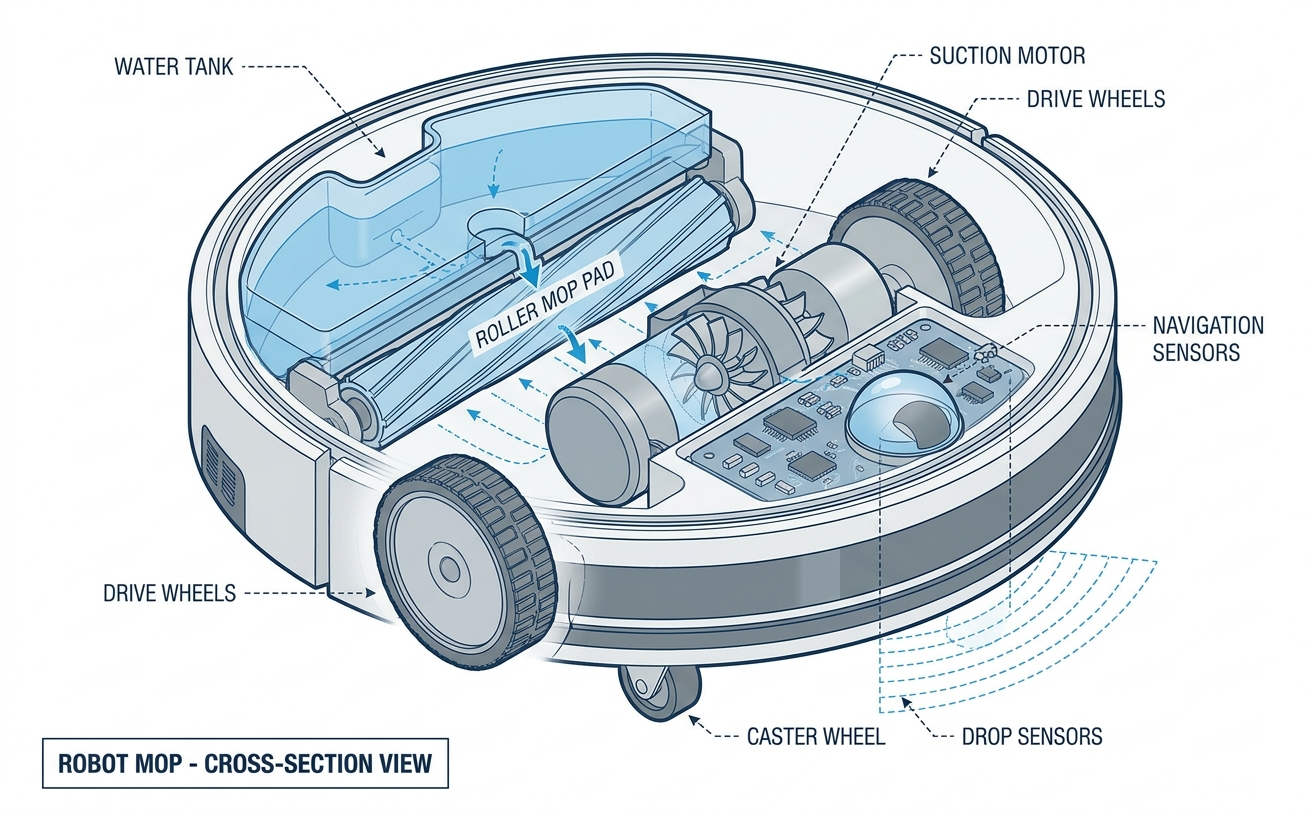
How a mopping robot distributes water, scrubs the floor, and collects dirty water
Most mid-range and premium mopping robots use LiDAR (laser-based distance mapping) or camera-based visual SLAM to build a digital floor plan of your home. The robot follows a systematic path, usually in straight parallel lines, covering every accessible section of floor without overlap or missed patches. Entry-level models sometimes rely on gyroscope or bump-based navigation, which works but is less efficient in larger spaces.
Once the robot finishes cleaning, it returns to its base station. On simpler models, this means parking on a charging cradle. On more advanced units, the station washes the mop pads with clean or heated water, dries them with warm air, refills the onboard tank, and empties collected dust. For a deeper look at each component, see how robot mop vacuums work.
Types of Mopping Robots
Mopping robots differ in two ways: whether they also vacuum, and how their mop pad contacts the floor.
Combo Vacuum and Mop Robots
The most common type on the market. A combo robot vacuums and mops in a single session, switching between modes or running both at once. Models with automatic mop-lifting raise the pad when transitioning onto rugs or carpet, keeping the fabric dry.
Dedicated Mopping Robots
Dedicated moppers focus entirely on wet cleaning. Some models excel at heavy scrubbing because they apply more downward pressure and carry larger water tanks. They suit homes that are predominantly hard-floor, where vacuuming is handled by a separate device.
Mopping Mechanism: Spinning, Roller, or Vibrating
Dual spinning pads rotate at high speed (typically 150–200 RPM) and press against the floor with measurable downforce. Spinning pads extend slightly beyond the robot’s body, which helps them reach closer to walls and furniture legs.
Roller-based (track) mops use a continuous belt that moves across the floor while being rinsed in real time. The pad picks up dirt in a straight line and is cleaned as it cycles through an internal rinse system, so it never applies a dirty surface back to the floor. The Narwal Flow uses this approach with its FlowWash system, rinsing the track mop with warm water in real time.
Vibrating or oscillating pads move rapidly back and forth rather than spinning. This works for everyday dust and light spills but doesn’t match spinning or roller systems for dried-on stains.
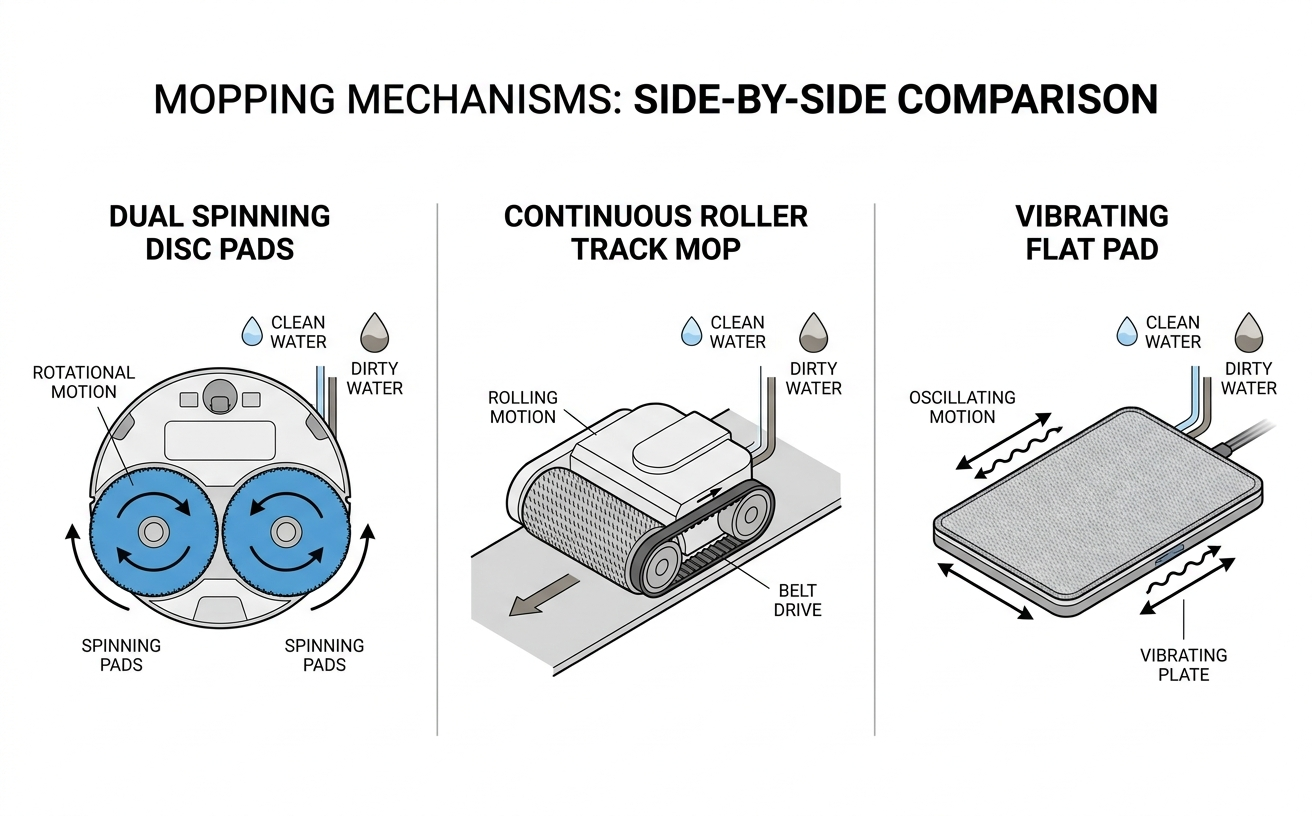
Three main mopping mechanisms compared: spinning pads, roller track, and vibrating pads
Spinning Pads vs. Rollers vs. Vibrating Pads
| Feature | Spinning Pads | Roller / Track Mop | Vibrating Pads |
|---|---|---|---|
| Scrubbing strength | Strong | Strong (continuous) | Moderate |
| Mop freshness during cleaning | Degrades over time | Self-rinses in real time | Degrades over time |
| Edge cleaning reach | Good (pads extend) | Good (track extends) | Limited |
| Best for | Dried stains, daily scrubbing | Large areas, consistent clean | Light dust, routine maintenance |
| Dock pad washing needed | After each session | Continuous + after session | After each session |
Roller systems rinse continuously, so performance stays more consistent across large floor areas. Spinning pads are available across more price points and brands, making them the most common choice.
Key Features to Look for in a Robot Mop
Beyond the mopping mechanism, the dock’s cleaning capability and how the robot handles carpet transitions have the biggest impact on daily usability.
Mopping Pressure and Scrubbing Action
Downward pressure separates robots that push dirty water around from those that genuinely scrub. Look for models that specify mopping pressure in Newtons (N). A range of 8–12 N is enough to tackle dried coffee, sauce, and similar household spills on hard floors.
Self-Cleaning Dock Stations
A self-cleaning dock washes the robot’s mop pads after each session, and higher-end docks use heated water for a more hygienic wash. Some also dry the pads with warm air, which prevents mould and odour.
Wash temperature is the main functional difference between docks. The Narwal Freo X10 Pro washes mop pads and dries them at 104°F, paired with a 120-day self-emptying dustbin for routine daily maintenance. The Narwal Flow’s dock washes at up to 176°F, which breaks down oily residue and provides a deeper sanitisation cycle.
Carpet Detection and Mop Lifting
When the robot detects carpet using ultrasonic or infrared sensors, it raises the mop pad (usually 9–12 mm) so the fabric stays dry. Essential for homes with both hard floors and rugs.
Navigation and Obstacle Avoidance
LiDAR navigation remains the most reliable option for mapping and systematic cleaning. Camera-based AI adds object recognition, allowing the robot to identify and avoid items like shoes, cables, and pet bowls. Some robots combine both systems. Dual RGB cameras paired with onboard AI chips can recognise over 200 types of objects and navigate around them with millimetre precision.
Water Tank Capacity and Runtime
For homes over 100 square metres, look for a clean-water tank of at least 200 ml on the robot itself, or a dock-based refill system that tops up the tank automatically. Battery life of 60 minutes or more will typically cover a standard Australian three-bedroom home in a single session.
Noise Level
For combined vacuum-and-mop mode, noise levels below 60 dB are quiet enough to run during the evening. If you plan to run the robot at night, look for a dedicated quiet mode at 55 dB or lower.
Mopping Robot Maintenance Tips
Most upkeep takes a few minutes per week. Five routines cover the essentials. For a full robot vacuum mopping maintenance guide, see our detailed walkthrough.
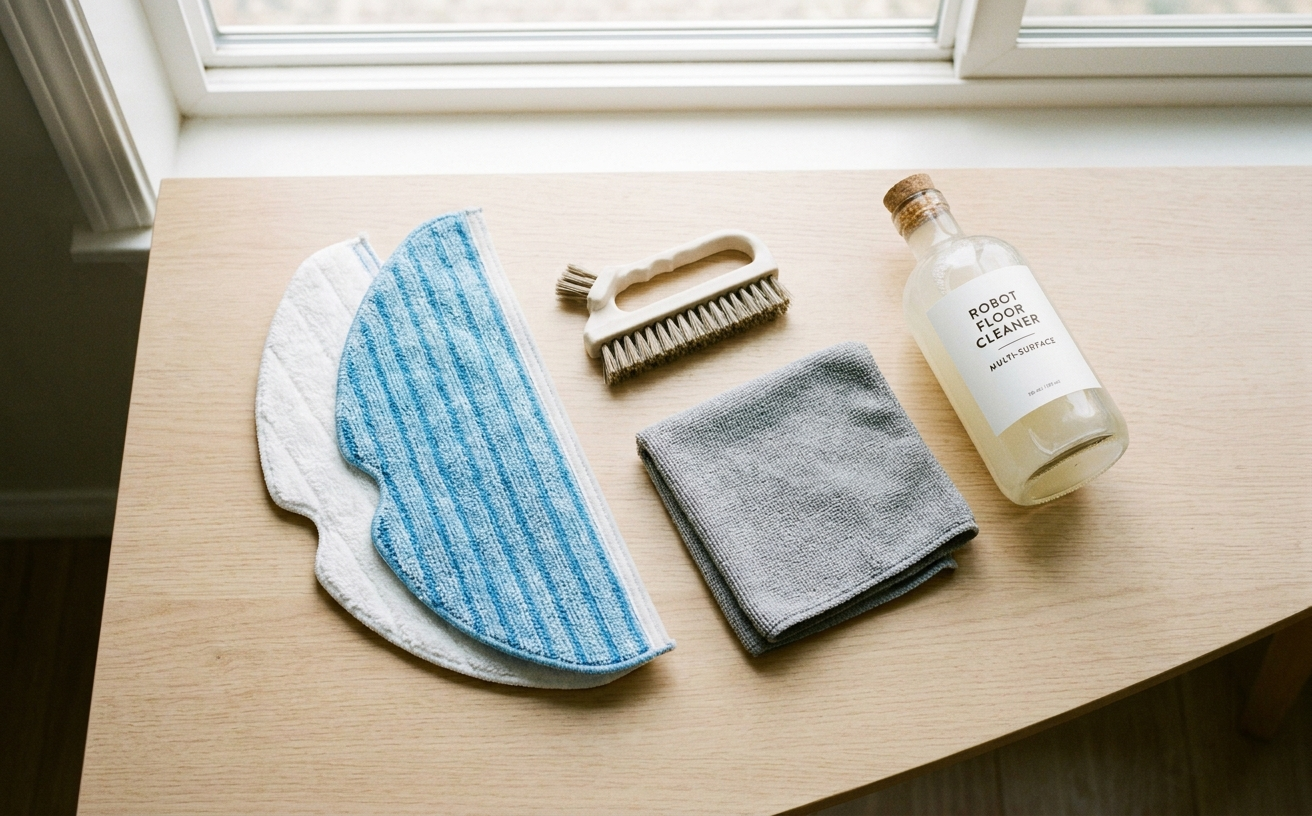
Essential mopping robot maintenance items: fresh pads, sensor brush, and cleaning solution
Wash or replace mop pads regularly. Even robots with self-cleaning docks benefit from a manual rinse every one to two weeks. Hot water and mild detergent remove built-up residue. Disposable pads should be swapped every one to three months depending on usage.
Clean sensors and wheels weekly. Wipe down the cliff sensors, navigation sensors, and drive wheels with a dry microfibre cloth. Dust on these sensors causes erratic behaviour or missed areas.
Only use recommended cleaning solutions. Unauthorised detergents or generic floor cleaners can damage the internal pump, void the warranty, and clog the water lines.
Empty and rinse the dirty-water tank after each session. Standing dirty water breeds bacteria and causes odour. Most tanks detach easily for rinsing under the tap.
Clear the floor before each run. Even robots with advanced obstacle avoidance can jam on cables, socks, and small toys.
How to Choose a Mopping Robot for Your Home
The best starting point is your flooring layout and the main mess your household produces.
For homes that are mostly hard floor (tile, timber, vinyl, or laminate), consistent mop freshness matters most. The Narwal Flow’s FlowWash track mop rinses itself with warm water continuously during cleaning, applying 12 N of downforce, so the pad that touches the floor is always clean. Its dock completes the cycle with a 176°F wash and 104°F warm-air drying.
For mixed flooring with carpets and rugs, automatic mop lifting is the deciding feature. The Narwal Freo X10 Pro lifts its mop pads 12 mm when it detects carpet, delivers up to 11,000 Pa suction, and resumes mopping when it returns to hard floor. Its extending triangular mop swings out to reach wall edges and toe kicks that round mop heads miss.
For pet households, tangle-free brush design is the priority. Pet hair wraps around standard roller brushes within weeks, requiring frequent manual cleaning. The Narwal Freo Z10 Ultra uses a DualFlow tangle-free system where the floating roller brush directs hair into the dustbin instead of winding around the shaft, verified at 0% hair tangling rate by SGS. It also delivers 18,000 Pa suction for pulling embedded fur from carpet fibres.
For smaller homes or apartments, a compact robot with long maintenance intervals reduces the overhead of owning a cleaning device. The Narwal Freo S stores dust for up to 180 days in its 3.5 L dock bag, runs at 8,000 Pa suction with automatic carpet boost, and operates at 62 dB or below.
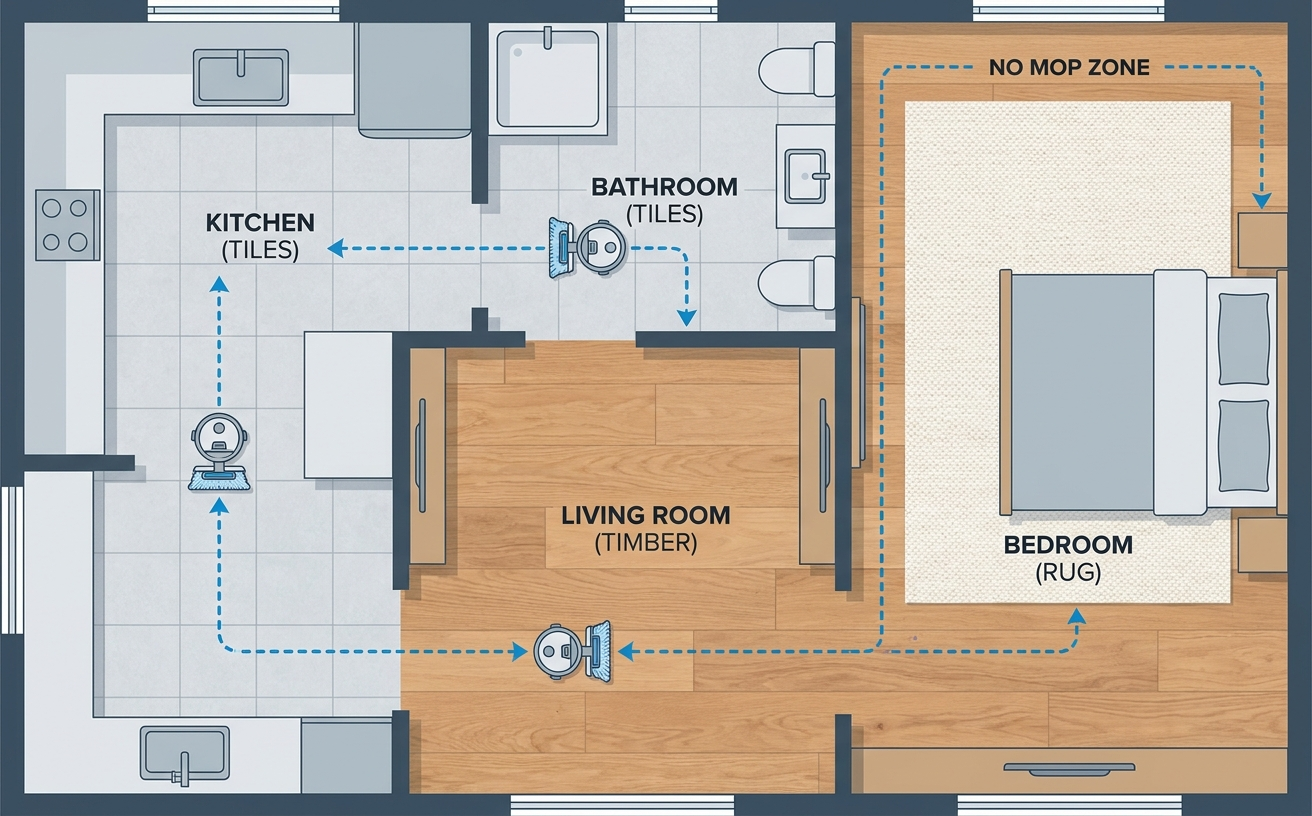
Choosing a mopping robot based on your home’s flooring layout
FAQs
Can a mopping robot replace hand-mopping entirely?
For routine daily cleaning, yes. For occasional deep-cleaning tasks like scrubbing grout or cleaning behind heavy furniture, you may still need a manual mop.
Do mopping robots work on all hard floor types?
Most mopping robots are safe for sealed hard floors including tile, vinyl, laminate, and sealed timber. Unsealed or waxed hardwood may be sensitive to water, so check the manufacturer’s guidance and use the lowest water setting.
How often should a mopping robot run?
Three to five times per week keeps floors consistently clean in a typical Australian household. Homes with pets or young children benefit from daily runs.
Is it safe to run a mopping robot on timber floors every day?
On sealed or polyurethane-coated timber, daily mopping with a robot is safe as long as the water flow is set to low or medium. Most robots with floor-type sensors reduce water output automatically on timber. Avoid daily robot mopping on unsealed, oiled, or waxed timber, as standing moisture can cause swelling or discolouration over time.
Do mopping robots need Wi-Fi to function?
Most can run basic cleaning cycles without Wi-Fi using onboard buttons. App connectivity unlocks scheduling, zone control, cleaning reports, and firmware updates. Most robots connect via 2.4 GHz Wi-Fi.


