




A cordless mop vacuum keeping hard floors clean across tile and hardwood
A mop vacuum combo is a single cordless device that vacuums dry debris and mops sealed hard floors at the same time, using separate water tanks so clean and dirty water never mix. For Australian homes where tile, hardwood, and laminate dominate, a well-chosen mop vacuum can replace both your stick vacuum and your mop bucket for daily cleaning, as long as you know which features to prioritise and which tradeoffs to accept.
Do Mop Vacuum Combos Actually Clean as Well as Separate Tools?
A quality mop vacuum with a self-cleaning function and two separate water tanks cleans hard floors to a standard most households won't notice a difference from using separate tools, as long as you match the machine to the job. The hesitation in most forum discussions, that combos always disappoint, comes from older or cheaper designs that circulate dirty mop water back onto your floors.
The key distinction is water management. A single-tank machine mixes dirty rinse water with clean supply water, so you're spreading progressively dirtier water across your floors as you go. A two-tank system keeps them separate throughout, so the last pass uses the same clean water as the first. That one design decision accounts for most of the performance gap between budget and quality combos.
For pet households, the other factor is whether the roller brush handles hair without frequent blockages. Machines with hair-cutting mechanisms built into the brush roll solve the tangle problem that standard rollers struggle with under regular shedding conditions. The same logic applies when comparing vacuuming and mopping as separate tasks — the value of doing both in one pass depends on whether the single machine handles each task to a standard you're satisfied with.
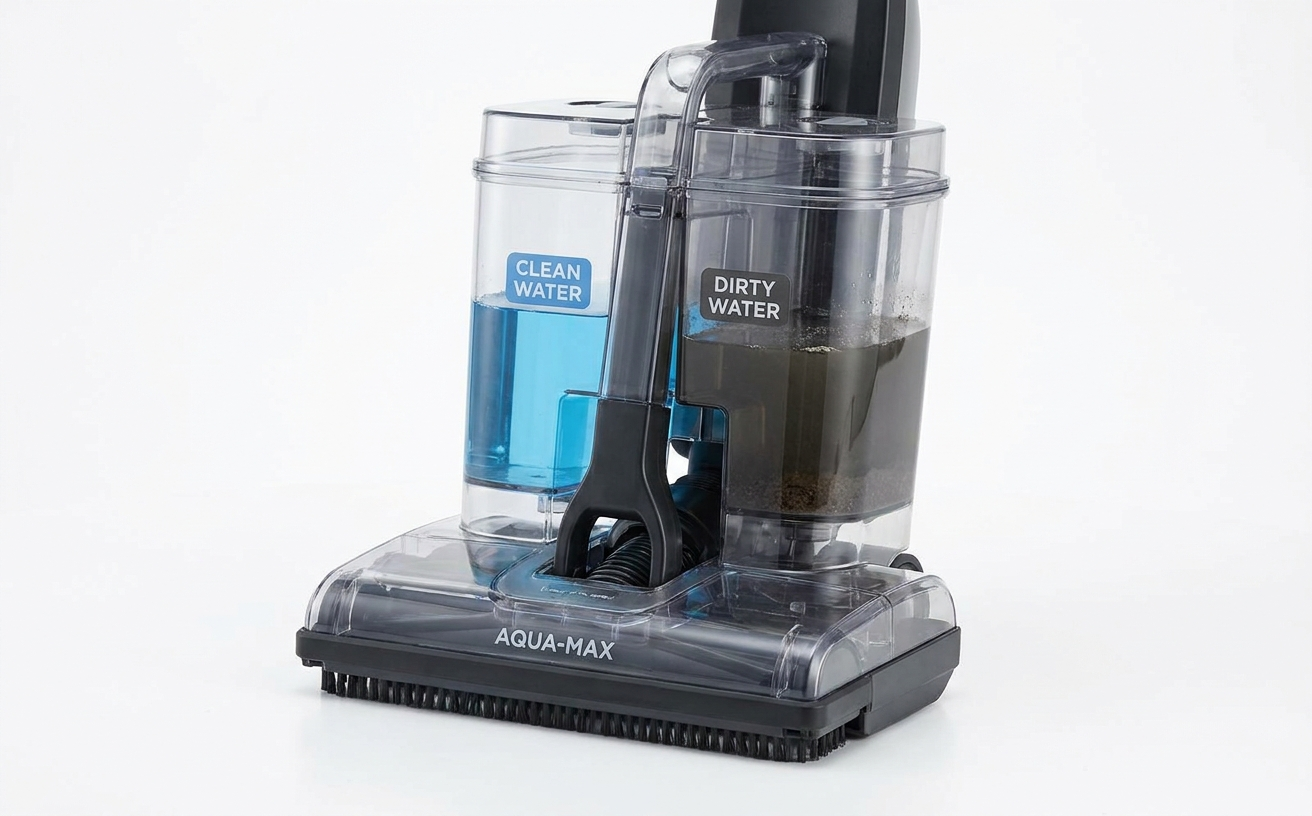
Two-tank design keeps clean and dirty water separate throughout the entire cleaning cycle
What Features Actually Matter in a Mop Vacuum
Specifications on a product page don't all translate to real cleaning performance. The features that consistently separate machines that work well from machines that disappoint after a few months come down to water management, drying, suction, runtime, battery, and edge reach.
Two-Tank Water Management
Two-tank water management is the single most important design feature. The rinse water for the brush roller comes from a clean supply, and extracted dirty water goes to a separate tank. Your floors get genuinely clean rather than a redistributed version of the same dirt.
Self-Cleaning vs. Self-Drying
Self-cleaning and self-drying are not the same thing. Self-cleaning rinses the roller brush after the session ends. Self-drying goes further and dries the brush roll and internal pathways with warm air, which is what prevents the mould and odour buildup that wet machines develop when left damp between uses.
Suction Power
Suction power in Pascal (Pa) determines how effectively the machine picks up dry debris before mopping. Quality cordless models typically sit between 15,000–20,000Pa. Below that range, fine particles and pet hair require multiple passes. Above 20,000Pa on sealed hard floors, particle removal rates reach 99% or better in lab conditions. Some manufacturers, including Bissell and Bosch, do not publish Pa figures for this category, so cross-brand comparisons sometimes rely on real-world reviews instead.
Runtime and Coverage
Runtime ranges from roughly 25 to 60 minutes depending on model and cleaning mode. A machine covering 340–400 m² per charge handles most standard Australian homes in a single session. Cordless is the better choice for the open-plan layouts common in contemporary Australian homes — a corded machine creates a tripping hazard and limits your range, and a 55–60 minute cordless runtime covers the same ground without the cable.
Battery Type
A machine with a non-replaceable battery has a defined lifespan. Once it degrades beyond usability, the whole unit needs replacing. Machines with replaceable battery systems extend usable life significantly, which matters at the $599–$999 price point this category sits at.
Edge Cleaning Reach
Models that clean flush to the left and right edges, rather than stopping several centimetres short, make a visible difference near kitchen kickboards and skirting boards. This is where spills and crumbs accumulate and where a poorly-designed machine leaves the most floor area for manual spot-cleaning.
Mop Vacuum vs. Separate Vacuum and Mop: Which Is Worth It?
A mop vacuum combo is worth it for households that clean hard floors frequently and want to cut the routine down to one tool and one pass. Eliminating the separate bucket, mop, and vacuum genuinely reduces both time and storage.
A separate vacuum and mop setup is the better choice when deep carpet cleaning is a significant requirement, when your floor area exceeds one charge cycle, or when you need the cleaning pressure and steam penetration that dedicated steam mops deliver.
The historical criticism that the mop side is always the weak link applies to older designs and budget products. Current mid-to-high-end cordless models in the AU$599–$999 range address the mopping quality gap directly with two-tank systems, high self-clean temperatures, and consistent downward mop pressure.
The Best Mop Vacuums in Australia (2026)
The comparison below covers the cordless mop vacuum options most commonly available in the Australian market, set against the features that determine real cleaning performance: suction power, self-cleaning capability, runtime, and coverage per charge. For a wider view of the category, our best mop and vacuum combo overview goes deeper on use cases beyond the comparison table.
| Model | Type | Suction | Self-Clean Temp | Runtime | Coverage | Price (AUD) |
|---|---|---|---|---|---|---|
| Narwal S30 Pro | Cordless wet/dry | 20,000 Pa | 194°F (90°C) | 60 min | ~400 m² | $999 |
| Narwal S30 | Cordless wet/dry | 20,000 Pa | 176°F (80°C) | 55 min | ~344 m² | $599 |
| Narwal S20 Pro | Cordless wet/dry | 20,000 Pa | 149°F (65°C) | 60 min | ~400 m² | $999 |
| Dreame H15 Pro | Cordless wet/dry | 21,000 Pa | 212°F (100°C) | 60 min | ~400 m² | ~$498–$1,092 |
| Bissell CrossWave HF3 | Cordless wet/dry | Not published | Cold-water rinse | 25 min | Not published | ~$429–$476 |
| Bosch Unlimited 7 ProHygienic Aqua | Cordless stick + mop attachment | Not published | None | 40 min | ~100 m² | ~$599–$699 |
Where the Narwal S30 Pro and the Dreame H15 Pro lead this comparison is on combined raw cleaning specifications: 20,000Pa-class suction with full 60-minute runtime. The Narwal S30 Pro's hair-cutting brush mechanism gives pet households a meaningful advantage, while the Dreame H15 Pro's higher self-clean temperature is its differentiator. The Bissell CrossWave HF3's 25-minute runtime and the Bosch Unlimited 7's 100 m² per-charge coverage mark the practical limits at the budget end of the segment, and neither delivers heated self-cleaning.
Narwal S30 Pro Cordless Wet Dry Vacuum
[cta:narwal-s30-pro-wet-dry-vacuums]
The Narwal S30 Pro cordless wet dry vacuum delivers 20,000Pa suction with a 20N downward mop pressure that keeps the roller in consistent contact with the floor on a single pass. The self-cleaning system runs at 194°F using hot water and back-and-forth spinning to clean each bristle individually, then dries the mop, pipes, and filter at the same temperature.
The built-in scissors and dual-layer comb cut and comb hair away during normal operation. The brush roll doesn't need manual clearing between sessions, even with regular shedding from pets or long hair.
The Narwal S30 Pro lies flat at 180° and pivots 63°, reaching under low furniture and around table legs without repositioning. It cleans flush to both left and right edges and within 2cm of the front edge. Runtime is 60 minutes, covering up to approximately 400 square metres per charge.
Narwal S30 Cordless Wet Dry Vacuum
[cta:narwal-s30-wet-dry-vacuums]
The Narwal S30 cordless wet dry vacuum matches the S30 Pro on suction power at 20,000Pa and downward mop force at 20N. Self-cleaning runs at 176°F (80°C), and hair management uses a dual-layer comb rather than the S30 Pro's scissor-comb combination. Runtime is 55 minutes with coverage up to approximately 344 square metres.
At $599, the Narwal S30 is the practical choice for households without heavy hair-tangle concerns or floor areas where the slightly shorter runtime is sufficient.
Can a Mop Vacuum Handle Rugs and Carpets?
Cordless mop vacuum combos are designed for sealed hard floors. Running the wet mop roller on carpet saturates the fibres rather than cleaning them. If your home has a significant mix of hard floors and rugs, you need a machine that automatically lifts the mop head on carpet detection. Otherwise you're switching modes manually between rooms.
For households where carpet vacuuming is as important as hard floor mopping, an automatic vacuum and mop handles the surface-switching without user input. Narwal Australia's robot range includes the Narwal Freo X10 Pro robot vacuum and mop and the Narwal Freo S robot vacuum and mop, both of which combine autonomous navigation with self-cleaning mop management. Our robot vacuum cleaner mopping guide walks through how mop pad management, water tanks, and surface detection work in this product category.
How to Maintain a Mop Vacuum Combo
The dirty water tank needs emptying after every use. Dirty water left sitting inside a warm machine is what causes the odour that owners of cheaper models report. On machines without a self-drying function, the roller brush also needs to be removed and air-dried separately after each session.
On machines with hot-air drying, the routine shrinks to: run the self-clean cycle, empty the dirty water tank. The filter still needs periodic cleaning, typically every few weeks, and the dirty water tank benefits from an occasional rinse beyond emptying.
Using a manufacturer-recommended cleaning solution matters more than most buyers expect. Third-party detergents that foam excessively can clog internal pathways and damage the motor over time. The Narwal cleaning solution for S-series models is formulated for low-foam output and auto-dispenses directly into the water supply during the cleaning run.
FAQs
Does a mop vacuum leave floors wet after cleaning?
A mop vacuum that uses a continuous fresh-water rinse and immediate dirty-water extraction leaves floors visibly damp rather than wet, with a typical dry time of three to five minutes on tile and hardwood. Machines without efficient water extraction tend to leave standing water and streaks, which is one of the clearest performance gaps between budget and quality designs.
Can I use a mop vacuum every day?
Daily use is the design intent for the Narwal S-series and most quality machines in this category. The components most likely to wear are the brush roller and the filter, both of which are user-replaceable. Battery degradation from daily charge cycles is the more meaningful long-term factor, which is why machines with replaceable battery packs hold up better over multiple years of frequent use.
Does a mop vacuum work on polished concrete floors?
Yes. Polished concrete is a sealed hard floor surface, which is what cordless mop vacuums are designed for. The same cautions that apply to other sealed floors apply here: avoid pooling water near unsealed joints or expansion gaps, and use a manufacturer-approved cleaning solution rather than abrasive detergents that can dull the polish over time.
Can I use a mop vacuum on laminate flooring?
Yes, provided the machine delivers controlled water output rather than saturating the surface. Laminate is sensitive to excess moisture at the joins. The Narwal S30, Narwal S30 Pro, and Narwal S20 Pro use a continuous fresh-water rinse system that maintains consistent, controlled moisture delivery throughout the cleaning run.
Do mop vacuum combos work on grout lines?
They clean surface buildup from grout effectively during routine maintenance. For deep-seated grout staining, a dedicated steam cleaner or grout brush will outperform a combo unit.


