
A robot vacuum navigating an Australian living room in 2026
An automatic vacuum cleaner in 2026 is not the same machine it was five years ago. Today’s robot vacuums map your home with LiDAR, mop with hot water, clean their own mops, and empty their own dustbins without you touching a thing. For Australian households dealing with a mix of hard floors, rugs, pet hair, and the occasional high threshold between rooms, the gap between a capable model and an underwhelming one is significant. Independent third-party certifications, including SGS testing for tangle-free brush performance and TÜV certification for on-device data privacy, are now reasonable benchmarks for separating engineering claims from marketing, alongside independent robot vacuum reviews from 2026.
At a Glance: Narwal’s Australian Robot Vacuum Lineup
Narwal Flow — the most automated of the three, with real-time mop self-cleaning during each pass, 22,000Pa suction, 120-day dust storage, and the ability to cross 40mm thresholds. AU$2,999.
Narwal Freo X10 Pro — the strongest fit for mixed-floor homes with pets or long hair: dual tangle-free system, 11,000Pa suction, 12mm auto mop lift on carpet, 7-week dust storage. AU$1,499.
Narwal Freo S — built around mopping intelligence rather than peak suction, with DirtSense repeat mopping, 8,000Pa suction, and adaptive cleaning by floor type. Best for hard-floor-dominant homes. AU$999.
What Makes a 2026 Automatic Vacuum Cleaner Different
The clearest shift in 2026 is full-cycle automation. Earlier robot vacuums handled vacuuming. The current generation handles vacuuming, mopping, mop washing, mop drying, dust emptying, and in some cases automatic water refilling from a single docked station. You set a schedule and the machine manages the rest. For a deeper look at how a robotic automatic vacuum works, the underlying systems break down into navigation, suction, mopping, and station automation.
Key technology advances that define this generation:
- Hot-water mop washing is now the threshold feature separating full-service docks from basic ones. Premium models heat water at the station to remove residue cool water cannot lift, with some systems sterilising at temperatures above 80°C.
- Anti-tangle brush engineering has become a measurable, certifiable spec rather than a claim. SGS-certified zero-tangle roller brush designs redirect hair into the dustbin instead of wrapping the axle, which matters in homes with long hair or pets.
- AI obstacle avoidance has replaced LiDAR-only navigation as the new baseline. Dual-camera and AI-chip combinations identify over 200 object types at millimetre precision, including small items like socks and cables that earlier models would collide with.
- Auto-empty stations have stretched dust storage from weeks to months. 100-day and 120-day dust capacity is now available at the top end, meaning most households empty the bag monthly rather than weekly.
- Carpet-specific behaviour now happens automatically, not as a setting. Sensors detect carpet and lift the mop, boost suction, and in some designs lower the brush cover to create a sealed high-pressure zone.
- Real-time dirt sensing has replaced fixed cleaning patterns. DirtSense and similar systems analyse dirty water or debris volume in real time and trigger repeat mopping in heavily soiled areas until the floor reads clean.
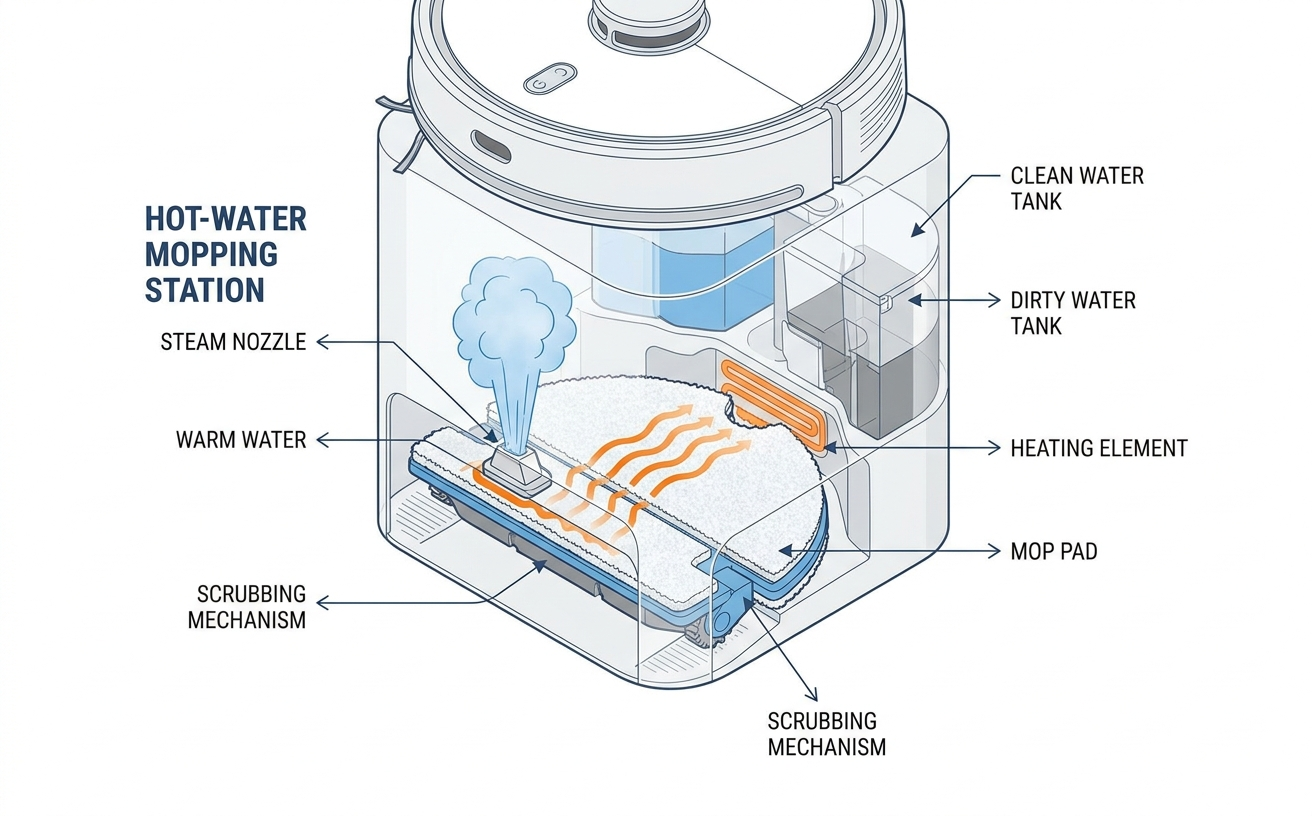
How a hot-water mop-washing station works in a modern automatic vacuum cleaner
How to Choose a Robot Vacuum for Your Australian Home
The right robot vacuum depends less on headline specs and more on the floor types it has to handle, whether pets or long hair are part of the picture, and how large or layered the home is. Four common scenarios cover most Australian households.
Primarily Hard Floors with Light Mopping Needs
If your home is mostly tiles, floorboards, or polished concrete with occasional rugs, a mid-range robot vacuum that combines vacuuming and mopping in one pass is the most practical choice. The Narwal Freo S robot vacuum and mop fits this use case well. It uses rotating dual mops with DirtSense technology to detect and re-mop dirtier areas, and its base station handles mop washing and drying automatically. For most households in this category, it removes the need for any supplementary mopping by hand.
Mixed Floors with Carpets
Mixed-floor homes need a robot that can vacuum carpet effectively and switch to mopping hard floors without dragging a wet mop across rugs. Suction matters more here than in any other use case. On hard floors, the practical difference between a well-designed 8,000Pa machine and one rated at 22,000Pa is negligible: both achieve near-complete particle removal. On medium-pile carpet, higher suction creates the airflow needed to pull debris from within the weave, and a brush cover that physically seals to the carpet surface (such as the CarpetFocus system on the Narwal Flow) makes a measurable additional difference.
The Narwal Freo X10 Pro robot vacuum and mop is built around exactly this scenario. It uses 12mm auto mop lift when carpet is detected, combined with 11,000Pa suction and dual-laser obstacle avoidance. It automatically switches between cleaning modes by floor type, scrubbing tile grout lines aggressively while protecting timber from over-saturation.
Homes with Pets or Long Hair
A machine that requires weekly manual brush cleaning defeats part of the automation benefit. Both the Narwal Freo X10 Pro and Narwal Flow use SGS-certified tangle-free roller brush designs that redirect hair into the dustbin rather than accumulating on the axle. The Narwal Flow goes further with a DualFlow Tangle-Free System where the side brushes also auto-switch formation to prevent side-brush tangling, which is a less common but equally frustrating maintenance issue.
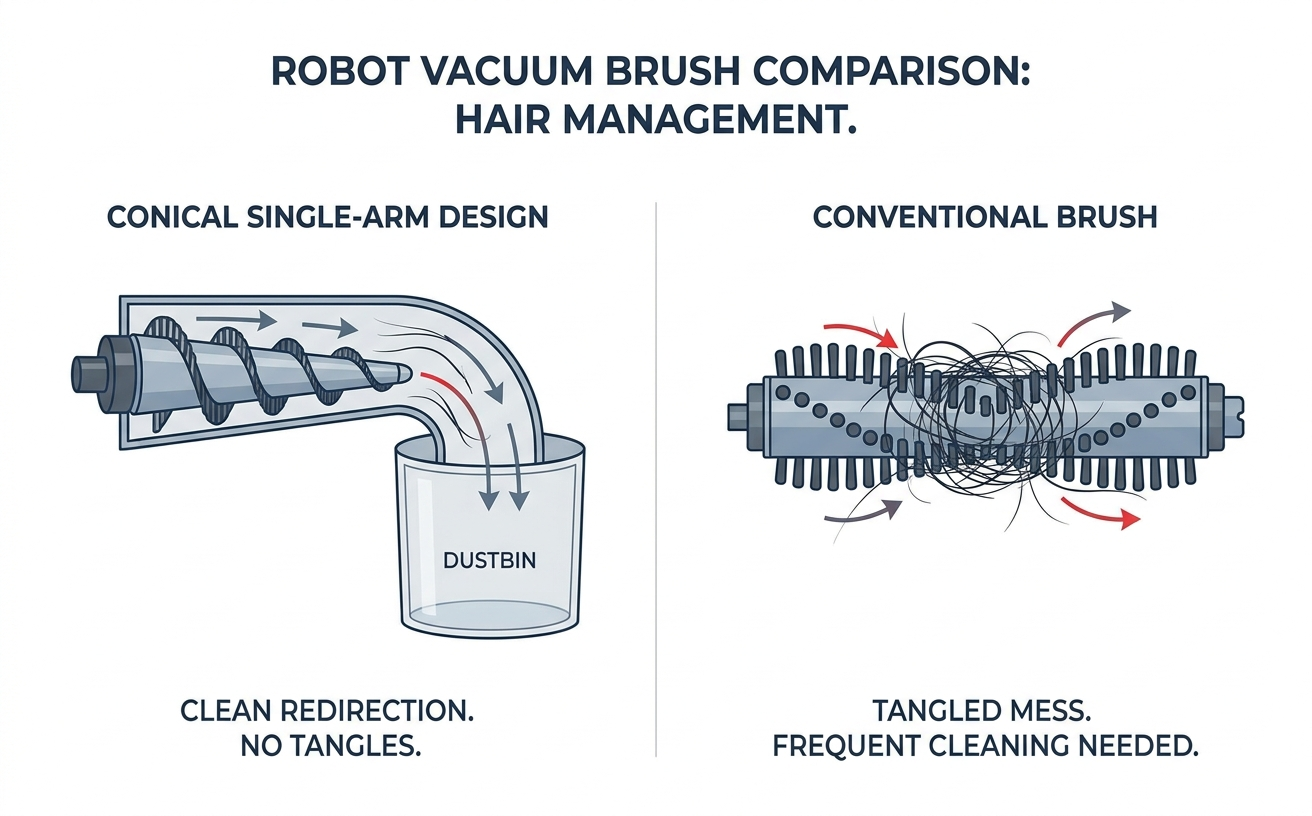
Anti-tangle brush design versus conventional brush: how hair is managed differently
Large Homes or Multi-Storey Layouts
For homes over 200 square metres or with multiple levels, battery life, mapping capability, and dust storage capacity become the deciding factors. The Narwal Flow and Narwal Freo Z10 Ultra both offer multi-floor mapping and extended auto-empty cycles of 120 days. The Narwal Flow’s ability to cross ledges up to 40mm high without being manually relocated is a practical advantage in older Australian homes with raised door thresholds or distinct room levels.
What Australian Homes Need from a Robot Vacuum
Three conditions show up more often in Australian homes than in the markets most international robot vacuums are designed around: raised thresholds between rooms, seasonal dust and pollen loads, and high rates of pet ownership. Each affects which features are worth paying for, and our broader guide to robotic hoovers in Australia covers the local context in more detail.
Many Australian homes have raised thresholds between rooms or between indoor and outdoor areas such as balcony access points. Standard robot vacuums stop at any ledge above 20mm. The Narwal Flow is designed to cross gaps up to 40mm, which covers most interior threshold variations in Australian residential construction without requiring a threshold ramp accessory.
Dust and pollen levels in Australian cities, particularly during spring in Sydney and Melbourne, are high enough that filter quality and dust storage capacity matter more here than in lower-particulate environments. A 120-day dust capacity rating is measured in standardised lab conditions; in a dusty Australian autumn, real-world capacity is typically shorter.
Pet hair is a significant concern in Australian households given high rates of pet ownership. In addition to choosing an SGS-certified tangle-free brush design, it is worth confirming that the model you select allows the brush to be removed without tools for inspection, which both the Narwal Flow and Narwal Freo X10 Pro support.
Narwal Robot Vacuums Available in Australia
Narwal’s current Australian range covers three robot vacuum and mop models, each tuned for a different priority: maximum automation, mixed-floor performance, or focused mopping intelligence at a lower entry point.
Narwal Flow: Full Automation from Floor to Station
Key features: FlowWash real-time mop cleaning | 22,000Pa suction | 12N mop pressure | 120-day dust storage | 40mm threshold crossing | TÜV-certified on-device AI | AU$2,999
[cta:narwal-flow-robot-vacuum-mop]
The Narwal Flow robot vacuum and mop represents the most complete automatic cleaning system Narwal offers. Its FlowWash mopping system cleans the track mop in real time during each cleaning pass rather than only cleaning it when the robot returns to the station. Warm water at 45°C is sprayed across the mop through 16 nozzles while a scraper removes residue, and dirty water is extracted back to the station. This means the mop is never spreading old dirt across a fresh area of floor.
The base station handles the rest: hot water mop washing at 80°C for sterilisation, 40°C warm air drying, 120-day dust storage, and auto water exchange. Navigation uses dual 136° RGB cameras paired with an onboard AI chip that identifies over 200 object types at 0.19-inch precision. At 95mm in height, it clears under most Australian bed frames and sofas without manual assistance.
Best suited to: Homes that want the least possible manual intervention and are willing to invest in the highest automation tier.
Narwal Freo X10 Pro: Strong Performance for Mixed-Floor Homes
Key features: Dual tangle-free system | 11,000Pa suction | 12mm auto mop lift | EdgeSwing edge cleaning | 7-week dust storage | AU$1,499
[cta:narwal-freo-x10-pro-robot-vacuum-mop]
The Narwal Freo X10 Pro robot vacuum and mop delivers the features that matter most in mixed-floor homes. Its dual tangle-free system covers both the roller brush and side brushes, and it runs on 11,000Pa suction with DirtSense technology for repeat mopping of dirty zones. The all-in-one base station washes and dries mops automatically, and stores dust for up to 7 weeks.
Ultrasonic floor sensors automatically detect carpets and switch between cleaning modes, lifting the mop 12mm to keep carpet fibres dry. The EdgeSwing function extends the mop and side brushes outward to reach skirting boards, corners, and toe kicks that fixed-format robots leave with a visible border of missed dust.
Best suited to: Households with a mix of hard floors and low-pile carpet, pet owners, or anyone with long hair living in the home.
Narwal Freo S: Intelligent Mopping with Adaptive Cleaning
Key features: DirtSense repeat mopping | 8,000Pa suction | 8N mop pressure | Mop wash + hot-air dry station | LiDAR navigation | AU$999
[cta:narwal-freo-s-robot-vacuum-mop]
The Narwal Freo S robot vacuum and mop is designed around mopping intelligence rather than maximum suction. Its DirtSense system analyses floor cleanliness in real time and determines where extra mopping passes are needed. The base station handles mop washing and hot-air drying, and the robot adapts suction, mop pressure, and moisture levels to the floor surface it detects.
Best suited to: Apartments or homes that are primarily hard floor, where consistent mopping performance is the main requirement.
If you want to weigh these models against each other on individual specs, our side-by-side comparison of auto vacuum cleaners lays out the full feature breakdown.
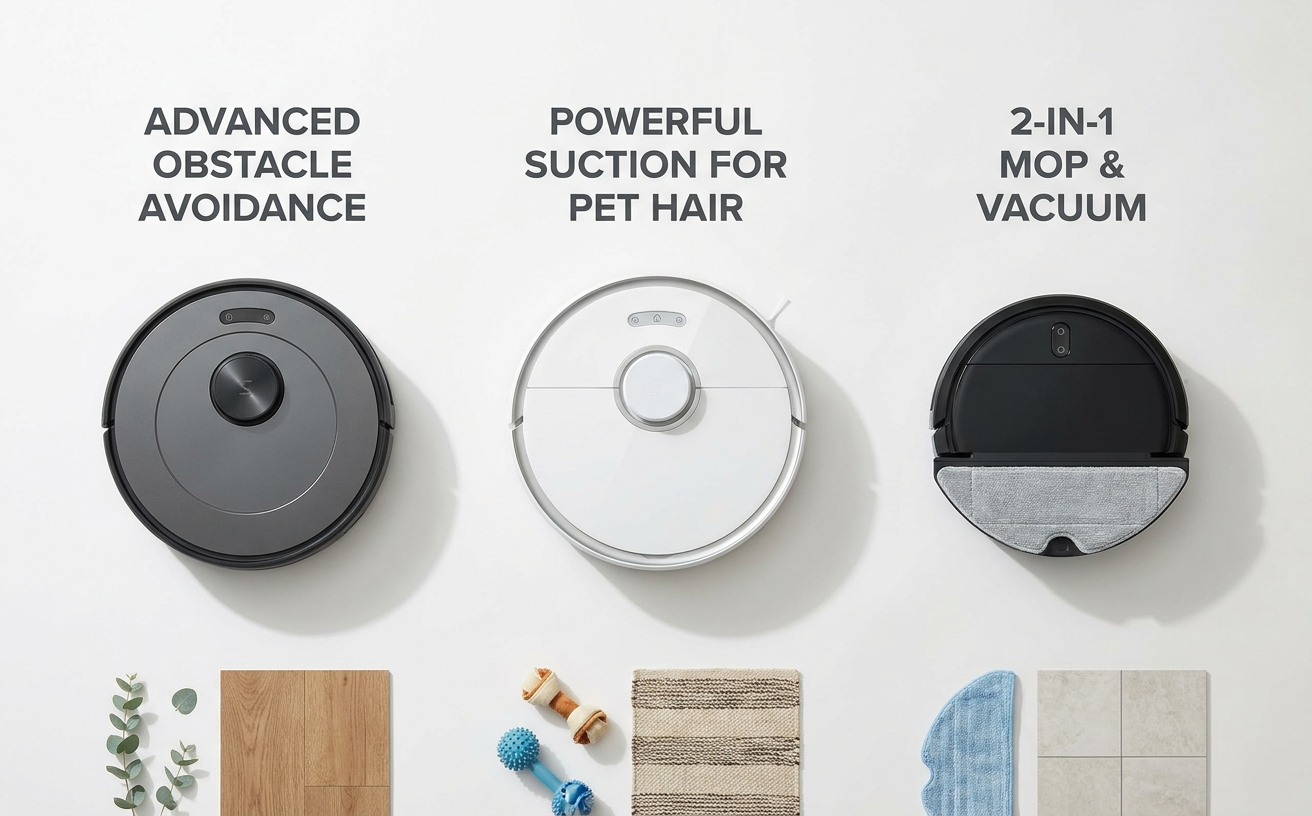
Choosing the right robot vacuum model for your Australian home
What Specs Don’t Tell You
Suction numbers and dust capacity dominate product pages, but four less-promoted factors do more to shape day-to-day satisfaction: how the station fits into your home, how loud it is at its worst, how deep the app control goes, and where the camera data is processed.
Station footprint matters in Australian homes with smaller laundry areas or hallways. A base station that requires a wide clearance zone or cannot tuck neatly against a wall becomes a persistent frustration. Narwal’s stations are designed to sit flush against walls and require no side clearance for the robot to dock.
Noise during station operation affects households that run cleaning cycles overnight. The Narwal Flow’s station operates at approximately 39dB during mop washing, which is quieter than most air conditioning units.
App control and scheduling depth determines how much you can tailor cleaning without being present. Narwal’s app supports room-specific modes, no-go zones, spot cleaning, and multi-floor map management. Voice control via Alexa and Siri is also supported across the range, which is relevant for households already running smart home devices.
Local data processing is a privacy consideration that receives less attention in reviews but matters for homes with children or security-conscious households. The Narwal Flow processes all camera data on its onboard AI chip rather than sending it to the cloud, and carries TÜV privacy certification.
Maintaining a Robot Vacuum: What’s Still on You
Automatic vacuum cleaners in 2026 have dramatically reduced hands-on maintenance, but they have not eliminated it. Four consumables and one routine inspection still require user attention.
Dust bag replacement remains necessary, typically every 1 to 4 months depending on home size and dust volume. Models with 120-day storage, like the Narwal Flow, stretch that interval further than average. Mop pads need replacement every few months with regular use, though most models signal when the pad has degraded. Filter replacement, usually every three to six months, maintains suction efficiency and is one of the most commonly overlooked maintenance steps.
The base station itself benefits from a periodic clean, particularly the water tanks and the drainage path. Most Narwal stations include self-cleaning of the dirty water tank, but inspecting it monthly takes less than five minutes and prevents odour buildup.
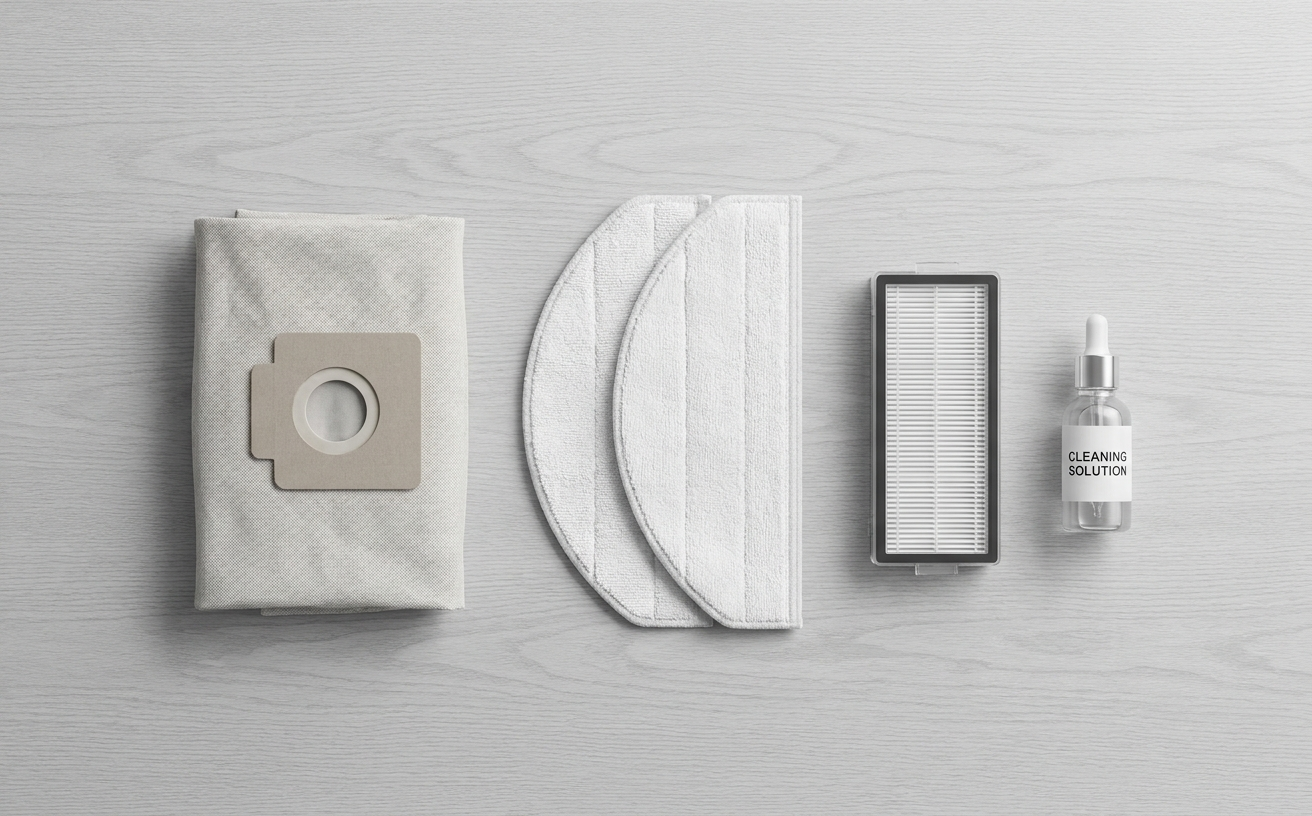
Robot vacuum maintenance items: dust bag, mop pads, filter, and cleaning solution
FAQs
What is the difference between an automatic vacuum cleaner and a robot vacuum cleaner?
They are used interchangeably in Australian retail. In 2026, an automatic vacuum cleaner almost always means a robot vacuum with autonomous navigation, mapping, and a self-maintaining base station.
Is paying for a flagship robot vacuum worth it over a mid-range model?
It depends on use frequency and floor mix. A flagship adds real-time mop self-cleaning, AI camera obstacle avoidance, and threshold crossing above 30mm. Daily use on mixed floors justifies the upgrade; small hard-floor apartments rarely do.
Can a robot vacuum replace mopping entirely?
For most Australian households, yes for daily maintenance. Robots handle hard floors well but cannot match scrubbing for dried-on residue, kitchen grease, or tracked-in mud. A monthly hand mop in high-traffic kitchen zones remains useful.
How well do robot vacuums handle long hair without tangling?
It depends entirely on brush design. SGS-certified zero-tangle brushes (used on the Narwal Freo X10 Pro and Narwal Flow) record a 0% tangle rate and 99.5% hair pickup. Conventional brushes wrap hair around the axle within days.
Are automatic vacuum cleaners safe around children and pets?
Yes. Modern robot vacuums use non-contact obstacle detection and stop or reroute around moving people or pets. App-set no-go zones exclude specific areas. The Narwal Flow processes camera data on-device rather than via the cloud.


