
A robotic hoover at home in a typical Australian open-plan living space.
Robotic hoovers are battery-powered cleaning robots that vacuum, and in many cases mop, your floors automatically. In Australia they are also searched for as automatic vacuum cleaners, vacuum cleaner robots or robot vacs, and the category now spans simple bump-and-go models under $500 to LiDAR-mapped, self-emptying machines above $2,000. The right model for an Australian home depends on how much carpet you have versus hard floor, whether you live with pets or shedding family members, and how much manual upkeep you are willing to do.
How Robotic Hoovers Work
A robotic hoover is a low-profile, disc-shaped appliance that drives itself around your home, picks up dust and debris with a roller brush and suction motor, and returns to a base station to recharge. Most current models in Australia also carry a water tank and either a flat mop pad or a spinning mop, which lets the same machine handle hard-floor wet cleaning. Higher-end docks empty the dustbin, wash the mop with hot water, refill the clean-water tank and dry everything between cleans.
The meaningful differences between models sit in four areas: navigation (LiDAR or AI camera versus random bumping), suction power (measured in pascals, Pa), the dock's level of automation, and how the brush system handles long hair and pet fur.
For a more detailed breakdown of the technology behind these machines, see our robotic automatic vacuum explained guide.
Are Robotic Hoovers Worth It for Australian Homes?
For homes with mostly hard floors, low-pile rugs and a regular need to deal with dust, sand, pet hair or shedding, a robotic hoover is generally worth it. They do not replace a corded barrel or stick vacuum for one-off deep cleans, end-of-lease blitzes or stairs, but they do replace daily and weekly maintenance vacuuming.
They tend to disappoint in homes that are mostly thick or high-pile carpet, in tight cluttered apartments where the robot cannot find a path, or when a budget bump-and-go model is expected to behave like a $2,000 LiDAR machine. Australia's consumer authority Choice has been blunt about carpet performance: in their independent lab tests, no robotic hoover from any brand has scored above 50% for sand pickup on carpet. On hard floors most models do well; on carpet, a traditional upright still does a deeper job for the weekly clean.
What to Look for in a Robot Vacuum

The four parts of a robotic hoover that most affect cleaning quality.
Navigation: LiDAR, AI camera or basic gyro
Navigation is the single biggest predictor of whether a robotic hoover finishes the job in one pass or wanders for an hour. LiDAR uses a small spinning laser turret to build a map of your home in minutes; AI-camera systems use one or two cameras to recognise objects and avoid them. Either is preferable to gyro-only or random navigation, especially in homes above about 60 m². Multi-floor mapping matters if you have a townhouse or two-storey home, since you only want to buy and store one robot.
Suction power for Australian floor types
Most Australian homes mix tile, timber and a few rugs or carpeted bedrooms. As a rough guide, 4,000 Pa is the practical floor for picking up fine sand and crumbs on hard surfaces, 8,000 Pa and above starts handling embedded dust on low-pile rugs, and 10,000 Pa or more is helpful if you have medium-pile carpet or shedding pets. Numbers above 20,000 Pa are real, but the gain over 10,000 Pa on a typical home is smaller than the marketing suggests, and Pa figures are not directly comparable between brands because each manufacturer tests under its own conditions.
Hair management and the brush system
Pet hair is the most common reason Australian buyers return a robotic hoover, and it is almost always a brush problem rather than a suction problem. A traditional dual-bristle roller traps hair around its centre shaft within days, then drags it across the floor instead of pulling it into the dustbin.
Anti-tangle systems use a few designs: a roller brush attached to the chassis on one side only, so hair slides off the free end into the dustbin; a conical or angled bristle layout that channels hair towards the suction inlet; and side brushes that switch between an open V-shape and a closed II-shape to release wrapped strands. Independent SGS or TÜV Rheinland anti-tangle certifications are a more reliable signal than brand claims alone. Some cordless wet-dry models add a built-in cutting comb that physically slices through accumulated hair.
The dock: what "self-emptying" really means
There are four levels of dock automation, each adding cost. The basic dock only charges. A self-empty dock pulls the dustbin contents into a sealed bag, typically lasting six to eight weeks. A wash-and-dry dock also rinses and dries the mop, usually with hot water and warm-air drying. The most automated docks add automatic clean-water refill and dirty-water drainage, sometimes plumbed in. Each level up reduces hands-on maintenance but increases footprint and price.
Mopping: damp pad vs. real scrubbing
Mopping ranges from a damp microfibre cloth dragged behind the robot, to spinning or vibrating pads that apply real downward pressure, to track-style or extending mops that reach within millimetres of skirting boards and toe kicks. If your floors are mostly tile or timber and stains are part of normal life, prioritise a model that scrubs rather than smears.
Battery life, dimensions and bridging
A 5,000 mAh battery typically covers 150 to 200 m² in mixed mode, which is enough for most apartments and many single-storey homes in one charge. Above that, look for resume-after-charge so the robot picks up where it left off. Slim-profile robots (under 100 mm tall) fit under modern lounges and beds; chunkier omni-station models often sit at 105 to 115 mm and may not. If your home has internal door thresholds, balcony lips or a step into a sunken lounge, check the listed obstacle-crossing height (commonly 20 to 40 mm).
Hygiene: Why Hot-Water Mop Washing Matters
A robotic hoover that mops picks up bacteria, pet dander and organic residue on every run. What happens next depends entirely on the dock. A cold-water rinse moves visible dirt off the mop pad but leaves bacterial colonies intact; the pad then sits damp in a sealed station, multiplying bacteria and producing the sour smell that many owners notice within two weeks. Studies on domestic cleaning textiles show that water temperatures below about 60 °C do not reliably kill common household bacteria such as E. coli and Staphylococcus aureus.
For households with shedding pets, young children who play on the floor, or anyone with dust-mite allergies, a dock that washes the mop at 60 °C or above and then dries it with warm air is a meaningful health upgrade, not a convenience feature. If your chosen model uses cold-water washing, manually removing and hot-washing the mop pads every few days is the workaround, but it adds back the hands-on time the robot was meant to save.
Choosing the Right Robotic Hoover by Home Type
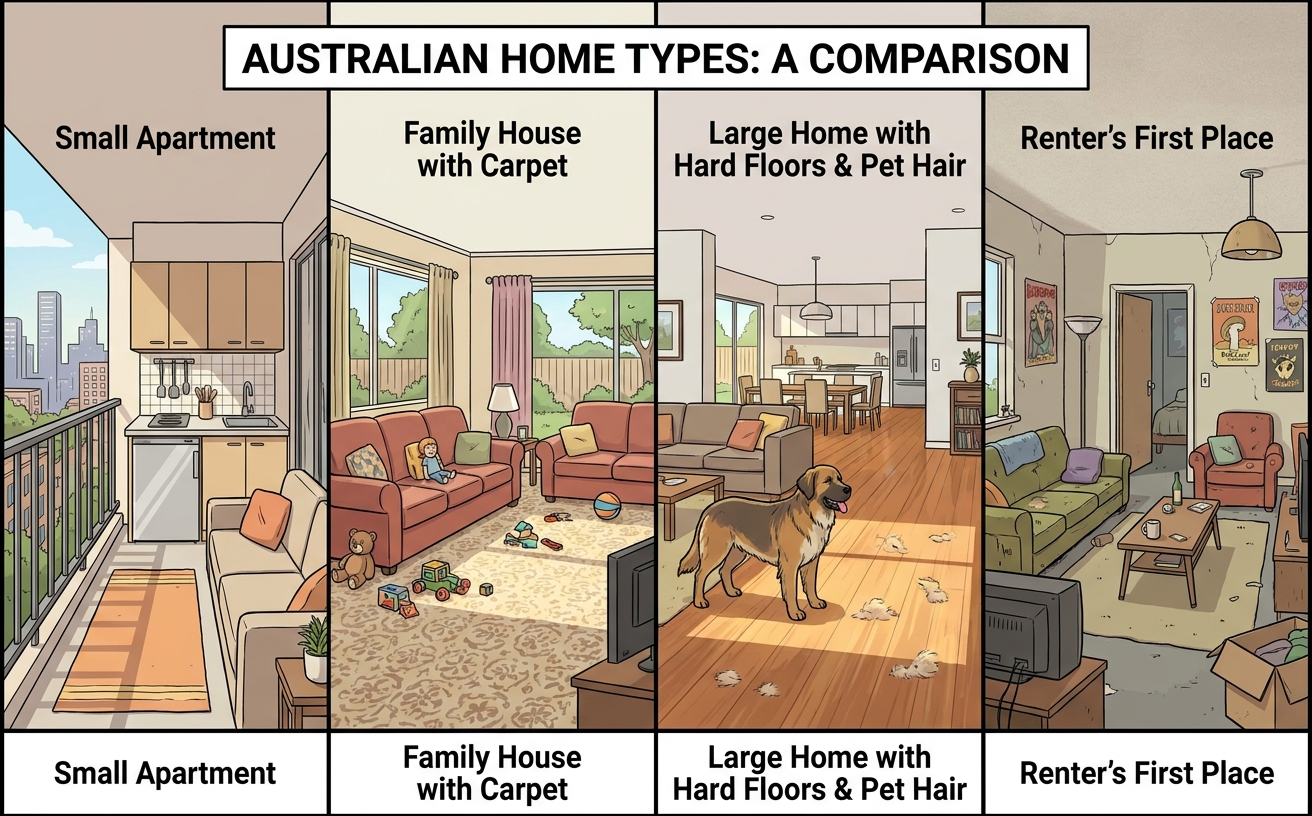
Different homes need different robotic hoovers.
Apartment under 80 m²
A mid-tier model with LiDAR or AI navigation, a basic self-empty dock and a slim chassis is usually enough. You do not need 20,000 Pa, multi-floor mapping or a full omni station. Prioritise low noise (under 60 dB) and a compact dock that fits beside the fridge or in a laundry.
Family home with mostly hard floors and a few rugs
A vacuum-and-mop combo with at least 8,000 Pa, automatic carpet detection that lifts the mop off rugs, and a wash-and-dry dock removes most of the daily cleaning workload. A LiDAR-mapped model that supports multiple floors is worth the upgrade if you have stairs.
Homes with shedding pets or long hair
Tangle resistance is the deciding factor, not suction. Look for an SGS- or TÜV-certified anti-tangle roller and a side brush that can change angle to release hair. A heated mop wash in the dock matters here too, because it stops the bacterial smell that builds up in mop pads when pets are involved.
Larger homes above 200 m²
Battery life and dock storage become the constraint. A 6,400 mAh or larger battery, resume-after-charge, multi-level mapping and a 2.5 L self-empty bag (good for around 120 days of typical use) keep a larger home running on one robot.
Renters and first-time buyers
An entry to mid-range model around the $600 to $1,000 mark gives you the core experience (LiDAR, app control, a self-empty dock) without committing to plumbing or a large station footprint. Australian retailers run heavy discounts during EOFY (May to June) and Black Friday, so timing the purchase matters more here than at the top end.
Popular Automatic Vacuum Cleaner Brands in Australia
iRobot (Roomba): the long-standing market leader, particularly strong on carpet pickup and reliability. Generally lighter on mopping features.
Roborock: known for accurate LiDAR mapping, high suction figures and aggressive feature releases at the premium end.
Ecovacs: broad range of vacuum-and-mop combos with full self-cleaning Omni docks across multiple price points.
Dreame: competitive specs at mid-range prices, often matching premium-brand suction figures.
Narwal: focuses on mopping performance and dock automation, with a robot range built around the Freo and Flow names plus the S-series cordless wet-and-dry vacuums.
TP-Link Tapo and entry brands: viable starting points if you want LiDAR navigation and a self-empty dock without a $1,500 outlay.
For independent test results across these brands, see our robot vacuum reviews Australia page.
Where Narwal Fits Into the Australian Line-Up
Narwal sells in over 30 countries and currently serves more than 1.8 million households worldwide. The Australian range is built around two product families: robot vacuum and mop combos under the Freo and Flow names, and cordless wet-and-dry stick vacuums under the S-series, which complement rather than replace the robots.
The Narwal Flow robotic hoover uses a track-style mopping system that rinses the mop with 45 °C water in real time, applies 12 N of pressure and reaches within 5 mm of skirting boards via an extending track. Its dual 136° RGB cameras and onboard AI chip handle obstacle avoidance with TÜV certification, the dock washes the mops with 78 °C hot water, and the maintenance-free dock can store dust for around 120 days. Suction is rated at 22,000 Pa, with carpet detection that auto-lifts the mop by 12 mm. The Flow supports both 2.4 GHz and 5 GHz Wi-Fi.
[cta:narwal-flow-robot-vacuum-mop]
The Narwal Freo X10 Pro robotic hoover uses 11,000 Pa suction with a triangular Reuleaux mop that extends and swings into corners, paired with an anti-tangle roller and a dynamic detangling side brush. It sits below the Flow's track-mop system but keeps the same edge-cleaning logic. It runs on the Narwal app, supports Alexa, Google Home and Siri, and connects to 2.4 GHz Wi-Fi only.
[cta:narwal-freo-x10-pro-robot-vacuum-mop]
The Narwal S30 Pro cordless wet-and-dry vacuum complements the robots for occasional manual cleaning between runs. It carries built-in scissors and a dual-layer comb to cut and clear tangled hair, runs for up to 60 minutes per charge, and uses 90 °C hot-water self-washing in its base.
[cta:narwal-s30-pro-wet-dry-vacuums]
Narwal Australia ships with a 2-year local manufacturer's warranty, free shipping over $100, a 30-day return window and the standard buy-now-pay-later options. Products are also available through Amazon Australia, Costco Australia and Harvey Norman.
Where to Buy Robot Vacuums in Australia
- The Good Guys, Harvey Norman and JB Hi-Fi carry the broadest range of mainstream brands and often have working displays, which is useful for seeing dock size in person.
- Bing Lee, Appliances Online and Costco compete heavily on price, especially during EOFY and Click Frenzy.
- Brand websites and Amazon Australia tend to launch new models first, and brand sites often bundle accessories such as extra mop pads and dust bags that retailers strip out.
- Kmart and similar low-cost retailers stock entry-level robots that work but lack mapping, app control and self-emptying.
Whichever channel you choose, check the local warranty length (two years is the common standard for Australian-sold premium models), whether spare parts such as side brushes and dust bags are stocked locally, and which payment options are available. Buy-now-pay-later services like Afterpay, Zip, PayPal and Klarna are widely supported on robotic hoovers in this price range.
Running Costs and Consumables
The sticker price is not the full cost. Robotic hoovers consume a small but predictable list of replaceable parts, and budgeting for them upfront avoids surprise expenses two years in. The figures below are typical Australian retail ranges for premium-brand consumables.
- Side brushes: replaced every three to six months. Around $15–$30 per pair.
- Roller brush: replaced every 12 months or when bristles fray. Around $30–$60.
- Mop pads: replaced every two to three months with regular mopping. Around $15–$40 per set.
- HEPA and clean-water filters: replaced every two to three months. Around $10–$25 per pack.
- Self-empty dust bags: replaced every six to seventeen weeks depending on bag size and household. Around $20–$40 for a multi-pack.
- Cleaning solution or detergent (where required): around $20–$40 per bottle, three to six months of use.
Total annual consumables typically land between AUD $80 and $200 for premium models running daily, more if you have multiple shedding pets. Electricity cost is minor: a typical robotic hoover draws under 50 W during cleaning and around 30 to 45 W when charging, which works out to a few cents per cycle at current Australian residential tariffs.
If you are ready to compare specific models side by side, our automatic vacuum cleaner 2026 guide covers the year's main releases.
Your Rights Under Australian Consumer Law
Robotic hoovers sold in Australia are covered by automatic consumer guarantees under the Australian Consumer Law (ACL), which sit alongside any manufacturer warranty. Under the ACL, a product must be of acceptable quality, fit for the purpose described and last for a reasonable amount of time. These rights apply even after a manufacturer warranty has expired, and "no refund" or "no refund on sale items" signs in stores are not enforceable when a product has a fault.
If a robotic hoover has a major failure, such as a motor that dies within months, repeated unfixable navigation faults or two or more minor failures stacking up, the buyer can choose between a refund or a replacement. For a minor failure the retailer is required to offer a free repair within a reasonable time. The retailer, not the manufacturer, is your first point of contact under the ACL, and they cannot push you to deal with the brand directly. If something goes wrong, contact the retailer first and reference the consumer guarantees; if that fails, the next step is the relevant state fair-trading agency or the ACCC.
What to Expect in the First Few Weeks
A robotic hoover gets noticeably better over its first month of use. LiDAR and AI-camera models build their map across the first two or three full cycles, learning room boundaries, no-go zones around pet bowls and rugs, and the most efficient route. Initial cleans often run longer than the listed time and may miss areas while the map fills in.
Before the first cycle, move floor cables, charging cords and lightweight rugs out of the way and remove tassels or fringes from rugs if possible. Tasselled rugs are the most common cause of a robot getting jammed mid-clean, regardless of brand. Robots with infrared cliff sensors can also struggle on dark or black flooring and dark-patterned carpets, which absorb the sensor's beam and can be misread as a drop-off, leaving the robot refusing to cross. Where this matters, look for models that support visual or LiDAR-based cliff detection rather than IR alone, or set the affected area as a no-go zone.
Australian humidity also plays a role. In humid climates like subtropical Queensland or coastal NSW, mopping cycles take longer to dry and the residual moisture on timber floors carries a higher risk of swelling if rooms are not ventilated. Consider running mop mode in the mornings when humidity is lowest, reducing the dock's mop-water output setting, or skipping mop mode entirely during extended wet weather. In drier inland areas the reverse applies: you may find the standard water level leaves floors dry almost immediately.
Common Mistakes When Buying a Robotic Hoover
- Choosing on suction figures alone, without checking brush design or navigation.
- Forgetting to check chassis height. A robot that is 105 mm tall will not fit under a sofa with 95 mm clearance, which is where most pet hair lives.
- Underestimating the dock footprint. Full omni docks can be 430 mm wide and 460 mm tall, plus space for the lid to open.
- Buying a mopping robot for a home that is mostly medium- or high-pile carpet.
- Not checking the Wi-Fi requirement. Some models support only 2.4 GHz, and mesh systems that auto-band-steer can cause setup failures.
- Ignoring spare-part availability. Side brushes, mop pads, dust bags and filters are consumables; confirm Australian stock before you commit.
- Overlooking dark flooring and tasselled rugs. Both are common deal-breakers that no amount of suction power fixes.
If you have worked through the considerations above and want a shortlist, see our picks for the best automatic vacuum in Australia.
FAQs
Are robotic hoovers good on carpet?
On low- and medium-pile carpet they can keep things tidy day-to-day, particularly models above 8,000 Pa with carpet detection that boosts suction automatically. On thick or high-pile carpet, results are mixed across the whole category, and a traditional upright still does a deeper job for the weekly clean.
How often do you have to empty a robotic hoover?
Models without a self-empty dock need emptying every one to three runs. Models with a self-empty dock typically last six to seventeen weeks before the dust bag needs changing, depending on bag capacity and household size.
Can a robotic hoover go between floors?
It cannot climb stairs. If you have a multi-storey home, look for multi-floor mapping, then physically carry the robot to the next level. The map for that floor is recognised automatically.
What is the difference between a robotic hoover and a robot mop?
A robot mop only mops; a robotic hoover usually means a combined robot vacuum, with mopping increasingly included as a built-in second function. Pure robot mops are now uncommon at the mid-range and above.
Do robotic hoovers work in the dark?
LiDAR-based models work fully in the dark because the laser does not need ambient light. AI-camera-based models perform best in normal lighting and may slow down or skip rooms in very low light.
Will a robotic hoover work on dark floors or black carpet?
Many models with infrared cliff sensors misread very dark surfaces as a drop-off and refuse to drive over them. Models that combine LiDAR or visual cliff detection with IR are more reliable on dark flooring; otherwise the affected area can be set as a no-go zone in the app.
How long do robotic hoovers last?
Three to five years is typical with regular brush, filter and battery replacement. Most premium models in Australia carry a 2-year manufacturer warranty as a baseline, and the Australian Consumer Law continues to apply beyond that for a reasonable period.
Does humidity affect mopping performance?
Yes. In humid Australian climates, mopping cycles leave floors wetter for longer and can risk swelling timber floors if rooms are not ventilated. Running mop mode in the morning or reducing the water output setting in the app helps. In dry inland areas, floors often dry within minutes.


