
A robotic automatic vacuum navigating a modern Australian home
A robotic automatic vacuum is a self-operating floor-cleaning device that handles vacuuming and, in many modern models, mopping as well, without you needing to push, guide, or supervise it. You set it up once, and it gets on with the job.
Not all robotic vacuum cleaners work the same way, and the technology behind them varies considerably between entry-level and more advanced units. Understanding how these machines actually operate helps you make a smarter buying decision and get more out of whichever model you choose.
What Is a Robotic Automatic Vacuum?
A robotic automatic vacuum moves independently around your floor space using sensors, onboard processing, and mechanical components to pick up dust, debris, and pet hair. Most current models also include a mopping function, making them combined robot vacuum and mop units rather than vacuum-only devices.
Unlike a standard upright or stick vacuum, a robotic cleaner operates hands-free. It navigates around furniture, avoids stairs and ledges, and returns to its charging dock when the battery runs low or the session is complete. Higher-end models can also self-empty their dustbins, self-clean their mop pads, and refill or drain water automatically via a base station.
Key Components and What They Do
Most robotic vacuums share the same core anatomy. The differences between models mostly come down to how each component is implemented.
Main Roller Brush
The roller brush sits underneath the robot and agitates the floor surface, loosening debris and guiding it into the suction path. On hard floors it sweeps particulates toward the intake; on carpet it works deeper into the pile to lift embedded dirt. Hair tangling around the roller brush is a common maintenance issue; some models use a conical or single-arm brush design to minimise this.
Side Brushes
Side brushes extend beyond the circular body of the robot to sweep debris from edges, skirting boards, and corners into the main cleaning zone. Their effectiveness along walls varies significantly between models.
Suction Motor
Suction power is measured in Pascals (Pa). Higher Pa ratings indicate stronger pickup, particularly for heavier debris and deep carpet cleaning. Entry-level models typically operate in the 2,000–4,000 Pa range; premium units can reach significantly higher. Suction is one spec worth comparing directly between models.
Dustbin
The internal dustbin collects everything the robot picks up. Standard capacity is modest, so most robotic vacuums need their bins emptied after every few sessions. Models with auto-empty base stations transfer debris from the robot's bin into a larger bag or container in the dock, extending the interval between manual interventions to several weeks.
Mopping System
Mopping functionality ranges from a passive damp pad dragged across the floor to active spinning or oscillating mop heads that apply downward pressure and scrubbing action. The latter performs considerably better on stuck-on grime. Mop auto-lifting is important in homes with both hard floors and carpet: without it, the damp mop will contact carpet every time the robot crosses between surfaces. For a deeper look at what to expect from combined cleaning, see our robot vacuum cleaner with mopping guide.
Water Management
Basic models include a fixed water tank in the robot itself. More advanced designs use the base station to supply clean water and collect dirty water, enabling longer mop sessions and hands-off maintenance. Some base stations also wash and dry the mop pads automatically after each run.

Key internal components of a robotic automatic vacuum
How Robotic Vacuums Navigate Your Home
Navigation is what separates a capable robotic cleaner from a frustrating one. Early robot vacuums bounced around rooms at random, which worked eventually but was inefficient and left gaps. Modern autonomous vacuums use structured navigation systems to map your home and plan systematic cleaning paths.
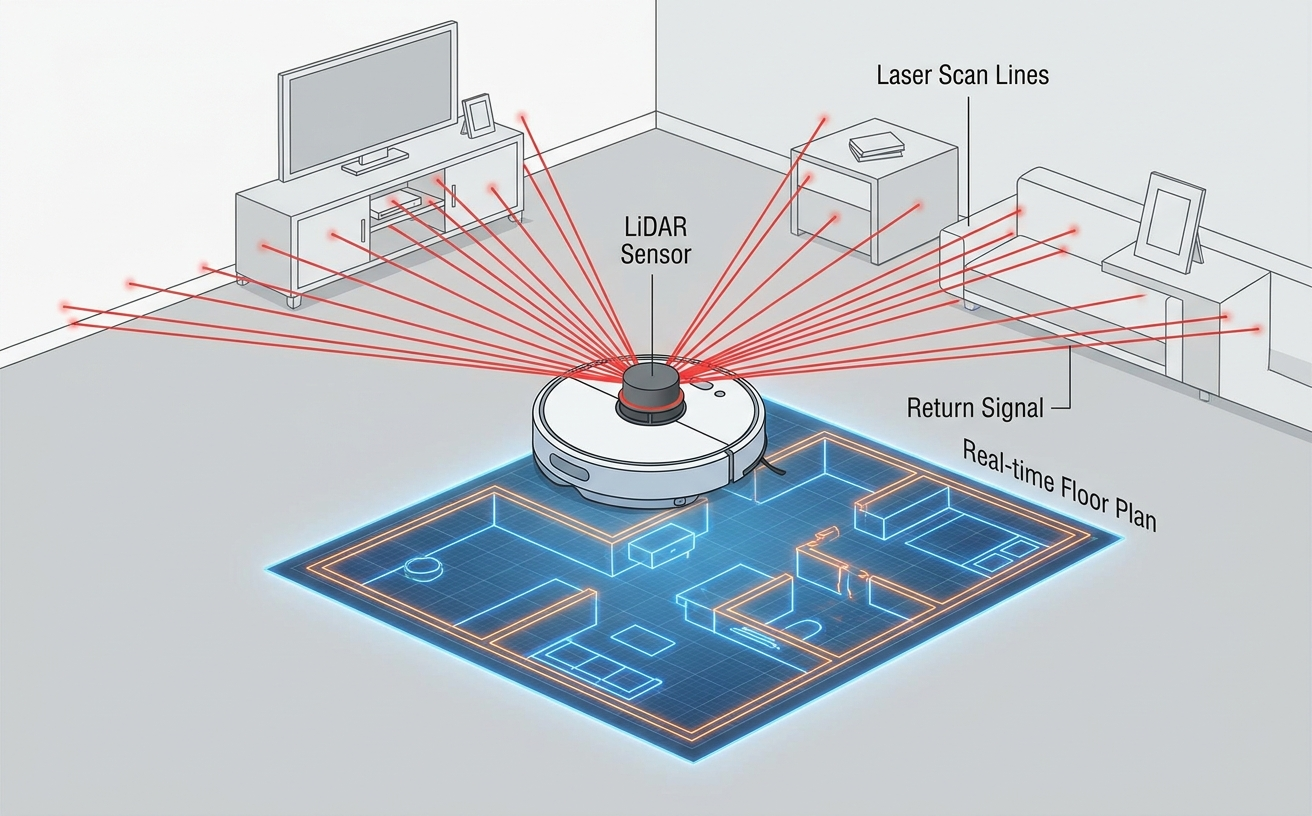
How LiDAR creates a digital floor map in a robotic automatic vacuum
LiDAR Navigation
LiDAR (Light Detection and Ranging) uses a spinning laser to measure distances in 360 degrees, building a precise map of your floor plan in real time. It works in complete darkness and delivers highly accurate spatial data. Most mid-range to premium robotic vacuums use LiDAR as their primary navigation system.
Camera-Based Navigation
Some models rely on cameras rather than lasers, using visual landmarks to determine their position. Camera systems can struggle in low-light conditions but tend to be stronger at recognising specific obstacles. For all-round reliability, LiDAR generally outperforms camera-only navigation; many premium models combine both, using LiDAR for mapping and cameras for object identification.
Sensor Arrays
Beyond the primary navigation system, robotic vacuums use supporting sensors: cliff sensors to detect stairs and ledges, infrared sensors for close-range obstacle detection, and wall sensors for edge cleaning. Premium models layer multiple sensor types together for more reliable performance in cluttered spaces.
SLAM Mapping
Simultaneous Localisation and Mapping (SLAM) is the algorithm that lets a robot vacuum build and update its map while cleaning at the same time. SLAM-based systems can adapt to changes in your home, like moved furniture, and resume cleaning from where they left off after returning to charge.
How a Cleaning Session Works
Once the hardware and navigation are working together, a typical cleaning run follows the same six-step sequence.
- Initial mapping: On its first run in a new space, the robot builds a digital floor map using its navigation system. This usually takes one full session. Subsequent sessions use the saved map for more efficient path planning.
- Path planning: Using the map, the robot calculates a systematic cleaning route, typically working in parallel rows. This covers the floor more thoroughly and reduces cleaning time compared to random-bounce navigation.
- Surface detection: As the robot moves, sensors detect changes in floor type. When it crosses onto carpet, it may boost suction and lift the mop. When it returns to hard floor, it may lower suction and resume mopping.
- Obstacle avoidance: The robot identifies and navigates around objects in its path. Entry-level models stop and reroute; advanced models with 3D sensors or AI cameras can identify specific object types and find the optimal path around them.
- Return to dock: When the battery reaches a set threshold, the robot returns to its base station to recharge. On larger floor areas it may return mid-session and resume where it left off once charged.
- Post-clean maintenance: Depending on the model, the base station may then auto-empty the dustbin, wash and dry the mop pads, and refill the robot's water tank, preparing it for the next session.
Smart Features Worth Having
Beyond core cleaning, the software side is where capable models earn their price. The features below meaningfully change daily use rather than just adding to the spec sheet.
- App control: Schedule cleaning sessions, set room-specific suction and water levels, review cleaning reports, and monitor the robot remotely.
- No-go zones: Define virtual boundaries in the app to prevent the robot from entering specific areas, such as around a pet's water bowl or beneath a low shelf.
- Multi-floor mapping: Save multiple floor maps for homes with more than one storey. The robot selects the correct map when placed on a given floor.
- DirtSense technology: Some models use sensors to detect areas with heavier soiling and repeat cleaning passes in those zones until the floor reads clean.
- Voice assistant integration: Compatible models can be controlled via Alexa, Google Home, or Siri.
- AI obstacle recognition: Advanced models use onboard cameras and AI chips to identify specific object categories, such as cables, shoes, or pet waste, and make real-time navigation decisions.
The Downsides of a Robotic Automatic Vacuum
A robotic automatic vacuum will not eliminate every cleaning task in your home. The honest limitations are worth knowing before you buy.
They Need a Tidy Floor to Work Well
Loose cables, socks, charging leads, and small toys are common causes of robots getting stuck or wrapping debris around their brushes. The more cluttered your floor, the more pre-clean tidying you'll do, which partly offsets the convenience.
Edges, Corners, and Stairs Stay Manual
Even with side brushes and edge-cleaning modes, robotic vacuums leave a thin band of dust against skirting boards and in tight corners that a manual vacuum reaches more thoroughly. Stairs always need a separate vacuum or attachment.
Mopping Is Surface-Cleaning, Not Deep-Cleaning
Robotic mopping handles light dirt and footprints well, but baked-on grime, sticky kitchen spills, and grout lines often need a manual clean. Treat the mop function as maintenance between deeper cleans, not a replacement for them.
Maintenance Is Reduced, Not Removed
Even with an auto-empty, mop-washing base station, you'll still empty the dust bag every few weeks, replace filters and mop pads periodically, and clear hair from brushes occasionally. The maintenance burden is lower than a regular vacuum, not zero.
Upfront Cost
Capable models with strong navigation, mopping, and an all-in-one base station sit at a noticeably higher price point than a good upright or stick vacuum.
How to Choose a Robotic Vacuum for an Australian Home
Once you know how these machines work and where they fall short, the buying decision comes down to matching the model to your home and habits.
Floor Types
Timber, tile, and polished concrete are common in Australian homes. On these surfaces, mopping performance matters as much as vacuuming. If you have a mix of hard floors and carpet, look for a model with reliable auto mop-lifting so carpet stays dry during combined vacuum-and-mop sessions.
Carpet and Rug Performance
Robot vacuums handle low-pile and medium-pile carpet well when paired with carpet detection and a suction boost. Performance drops on deep, plush pile, where suction alone struggles to lift embedded debris. Tasselled or fringed rugs are a known weak point: side brushes and roller brushes can catch in fringes, occasionally pulling threads or stalling the robot. Either flip fringes under the rug, mark the rug as a no-go zone in the app, or choose a model with edge-detection that slows down at rug borders.
Pet Hair
Pet hair is one of the most demanding cleaning challenges for any robotic vacuum. Tangle-free roller brush designs reduce maintenance time significantly. Check for independent certifications on hair pickup and tangle resistance rather than relying on marketing claims alone.
Home Size and Layout
For larger homes or multi-storey layouts, battery capacity and multi-floor mapping are important. For open-plan spaces, strong navigation accuracy ensures fewer missed patches. For homes with lots of furniture or clutter, more sophisticated obstacle avoidance reduces the chance of the robot getting stuck.
Noise Level
Robot vacuum noise typically ranges from around 55 dB on quiet modes to 75 dB or higher on maximum suction. Anything above 70 dB becomes noticeable in adjacent rooms. If you plan to run the robot during work-from-home calls or while children are sleeping, check the manufacturer's stated decibel level on each suction mode, not just the lowest figure.
Base Station Footprint
All-in-one base stations that auto-empty, wash mops, and manage water are larger than basic charging docks. Check the dimensions before purchasing and confirm the station will fit in your planned space.
Maintenance Frequency
A model with auto-empty and auto-mop-washing genuinely extends the interval between manual maintenance. If that matters to you, factor the total cost of ownership, including replacement consumables, into the decision. For a full breakdown of what to compare before buying, see our robot vacuum cleaner Australia buying guide.
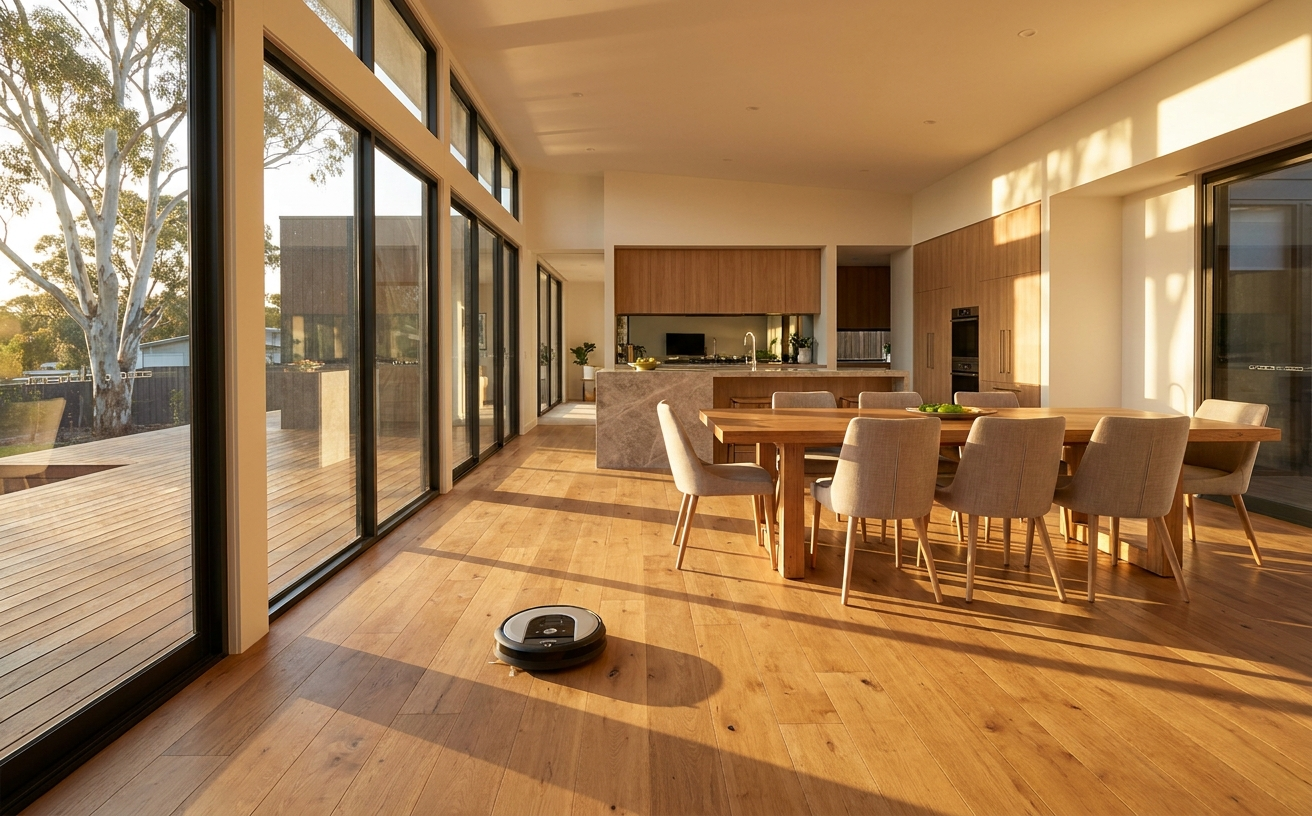
A robotic automatic vacuum working on timber floors in an Australian home
Robotic Automatic Vacuums from Narwal Australia
Narwal's current Australian range covers four robot vacuum and mop models. Here is what each one does and who it suits.
Narwal Flow
The Flow's defining feature is its FlowWash track mop, which self-cleans in real time as the robot moves: 16 nozzles spray 113°F water, a scraper strips residue from the mop, and dirty water is continuously extracted. The result is a fresh mop on every pass rather than one that spreads dirt around. Suction runs at 22,000 Pa, CarpetFocus technology seals the brush cover against carpet to lift embedded debris, and the mop auto-lifts 12 mm to keep carpets dry. The base station sterilises with 176°F water and stores dust for up to 120 days.
Suits homes that mop frequently or have hard floors as the dominant surface, and anyone who wants the longest possible interval between hands-on maintenance.
[cta:narwal-flow-robot-vacuum-mop]
Narwal Freo X10 Pro
The X10 Pro is built around hair management. Its DualFlow system addresses tangling at both points where hair causes problems: the side brush switches between V and II positions to shed hair rather than wrap it, and the conical floating roller brush carries strands directly into the dustbin. SGS-certified 0% tangling rate. Suction is 11,000 Pa. The MopExtend system swings the dual mops to cover edges and toe kicks, applying 8N downward pressure at 180 RPM. The base station handles auto-empty, mop washing, and hot-air drying for up to 120 days.
Suits homes with pets, long-haired occupants, or anyone who wants to eliminate brush-clearing from their routine.
[cta:narwal-freo-x10-pro-robot-vacuum-mop]
Narwal Freo S
The Freo S delivers 8,000 Pa suction with LDS laser navigation, an 8N mop system, and Carpet Boost that lifts suction automatically on carpeted areas. The auto-empty base uses a 3.5L dust bag rated for up to 180 days, the longest interval in the Narwal Australia range. Noise stays at or below 62 dB.
Suits households that want a capable vacuum-and-mop robot with minimal bin maintenance and quieter operation.
[cta:narwal-freo-s-robot-vacuum-mop]
Narwal Freo Z10 Ultra
The Z10 Ultra runs at 18,000 Pa, uses dual 136° cameras with twin AI chips, and navigates via LiDAR 4.0 with multi-floor 3D mapping. The EdgeReach triangular mop extension reaches corners that circular mops miss. Its AI-adaptive base station adjusts wash water between 113°F and 167°F based on the dirt type detected on the mop pads, and self-empties for up to 120 days.
Suits larger homes, multi-storey layouts, or anyone who wants the most thorough obstacle avoidance and automated mop maintenance available in the range.
[cta:narwal-freo-z10-ultra-robot-vacuum-mop]
For a side-by-side comparison of Narwal and other models currently available in Australia, see robot vacuum reviews Australia 2026. To explore the full automatic vacuum range, see our best automatic vacuum cleaner 2026 roundup.
FAQs
What is the average lifespan of a robot vacuum?
Most robotic automatic vacuums last four to six years with regular maintenance. Battery capacity typically declines first, around the three-to-four-year mark, while brushes and filters need replacement every six to twelve months.
Do robotic automatic vacuums work on carpet?
Yes, on low-pile and medium-pile carpet most modern models perform well, especially those with carpet detection that automatically boosts suction. Deep plush pile is harder to clean thoroughly, so check the suction rating before buying.
Can a robotic vacuum replace a regular vacuum cleaner?
For day-to-day floor maintenance, yes. For stairs, upholstery, car interiors, and tight corners, you'll still want a stick or upright vacuum. Most households use the two together rather than replacing one with the other.
How often does a robotic automatic vacuum need maintenance?
Empty the dustbin every one to three sessions on basic models, or every few weeks with an auto-empty dock. Clear the brushes weekly, replace filters every two to three months, and replace mop pads as they wear.
What does Pa mean on a robot vacuum spec sheet?
Pa stands for Pascal, the unit measuring suction pressure. Higher Pa means stronger pickup, particularly on carpet and heavier debris. Above 5,000 Pa is strong; above 10,000 Pa is high-performance. Pair it with brush quality for the full picture.
Are robotic automatic vacuums suitable for large Australian homes?
Yes. Most current models cover 150 to 300 square metres per charge and will auto-return, recharge, and resume cleaning to finish the job. Multi-floor mapping is worth prioritising for multi-storey homes.
Can I use a robotic vacuum if I have pets?
Yes. For pet households, prioritise high suction, a tangle-free roller brush with SGS or TÜV certification, and a high-efficiency filter for allergens. An auto-empty base station is especially useful, since pet hair fills small dustbins quickly.
How do robot vacuums deal with doors?
Open doors are crossed normally as part of mapped cleaning. Closed doors are treated as walls. Half-open doors can confuse navigation and are best either fully open or fully closed during cleaning sessions for best results.
Can robot vacuums handle wet floors?
Robot vacuums are not designed for standing water and can be damaged by liquid spills picked up through the dustbin path. The mopping function uses a damp pad, which is fine, but mop up larger spills before running a cleaning session.
Is it okay to run a robot vacuum every day?
Yes. Daily use is what these devices are designed for and helps keep dust and pet hair under control. Expect to replace consumables like filters, brushes, and mop pads slightly more often than with occasional use.
For a broader overview of robovac options in Australia, see our robovac guide. If you're also considering corded or handheld models, the robotic hoovers Australia guide covers a wider range of autonomous cleaning options.


