
A robovac navigates a typical Australian living room
A robovac cleans your floors automatically, returning to its dock when the job is done. If you're new to how a robot vacuum works, the basics are straightforward, but not every model is built the same. Buying the wrong one for your home means dealing with missed spots, tangled brushes, or a machine that gets stuck every other day. This guide breaks down the features that actually matter, so you can make a confident choice.
Navigation and Mapping
Navigation is the foundation of how well a robovac works. A machine that maps your home accurately will cover every room in a logical, efficient pattern rather than bouncing around randomly.
LiDAR (laser-based) navigation is the current standard for accurate home mapping. The sensor rotates and sends laser pulses to measure distances across a room, building a precise floor plan even in the dark. Models with LiDAR SLAM technology can store multiple floor maps, making them suitable for multi-storey homes. With a saved map loaded into the companion app, you can set specific rooms to clean, create no-go zones around pet beds or children's play areas, and schedule cleans for particular zones.
Some models pair LiDAR with 3D structured light or camera-based sensors for better obstacle detection. This combination is especially useful in homes with cluttered floors, pets, or low-profile furniture.
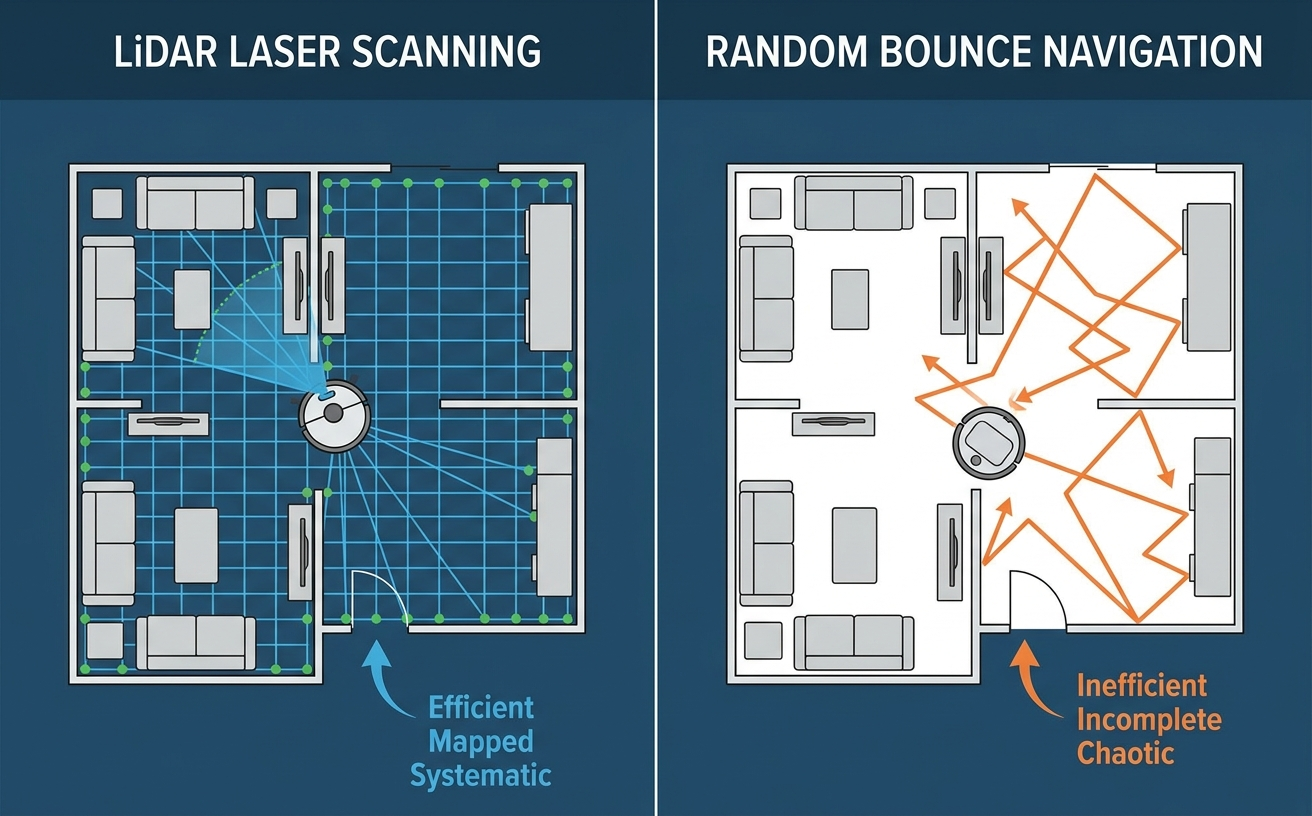
LiDAR navigation creates an accurate map; random bounce navigation misses areas
Suction Power for Different Floor Types
Suction power is measured in Pascals (Pa). It determines how effectively the robot vacuum lifts dust, pet hair, crumbs, and larger debris from different floor types.
For hard floors like tiles, timber, and vinyl, most models above 2,000 Pa perform reliably. The difference becomes more significant on carpets, where debris is embedded in the pile. For low-pile carpet, look for at least 4,000 Pa. For medium to high-pile carpet, models with 6,000 Pa and above will produce noticeably better results.
Many mid-range and flagship robovacs now include automatic carpet detection, which boosts suction when the machine transitions from hard floor to carpet.
| Floor Type | Recommended Suction |
|---|---|
| Hard floors (tiles, timber, vinyl) | 2,000 Pa and above |
| Low-pile carpet | 4,000 Pa and above |
| Medium to high-pile carpet | 6,000 Pa and above |
| Mixed home (hard floor + carpet) | 6,000 Pa+ with auto carpet boost |
Brush Design and Hair Tangling
Brush tangling is one of the most common frustrations with robot vacuums, particularly in households with pets or people with long hair. A tangled brush reduces suction and requires regular manual clearing.
Rubber rollers and anti-tangle designs address this problem in different ways. Some models use a conical single-arm brush that guides hair aerodynamically into the dustbin rather than wrapping it around the brush shaft. Others use side brush designs that retract or reverse direction to shed hair before it can accumulate. SGS or TÜV certification is a reliable indicator of verified tangle-free performance.
Side brushes sweep debris from edges and corners into the vacuum's path. On high-quality models, these brushes extend or swing outward to reach along skirting boards. Some can automatically reverse direction to prevent hair tangling at the side brush arm as well.
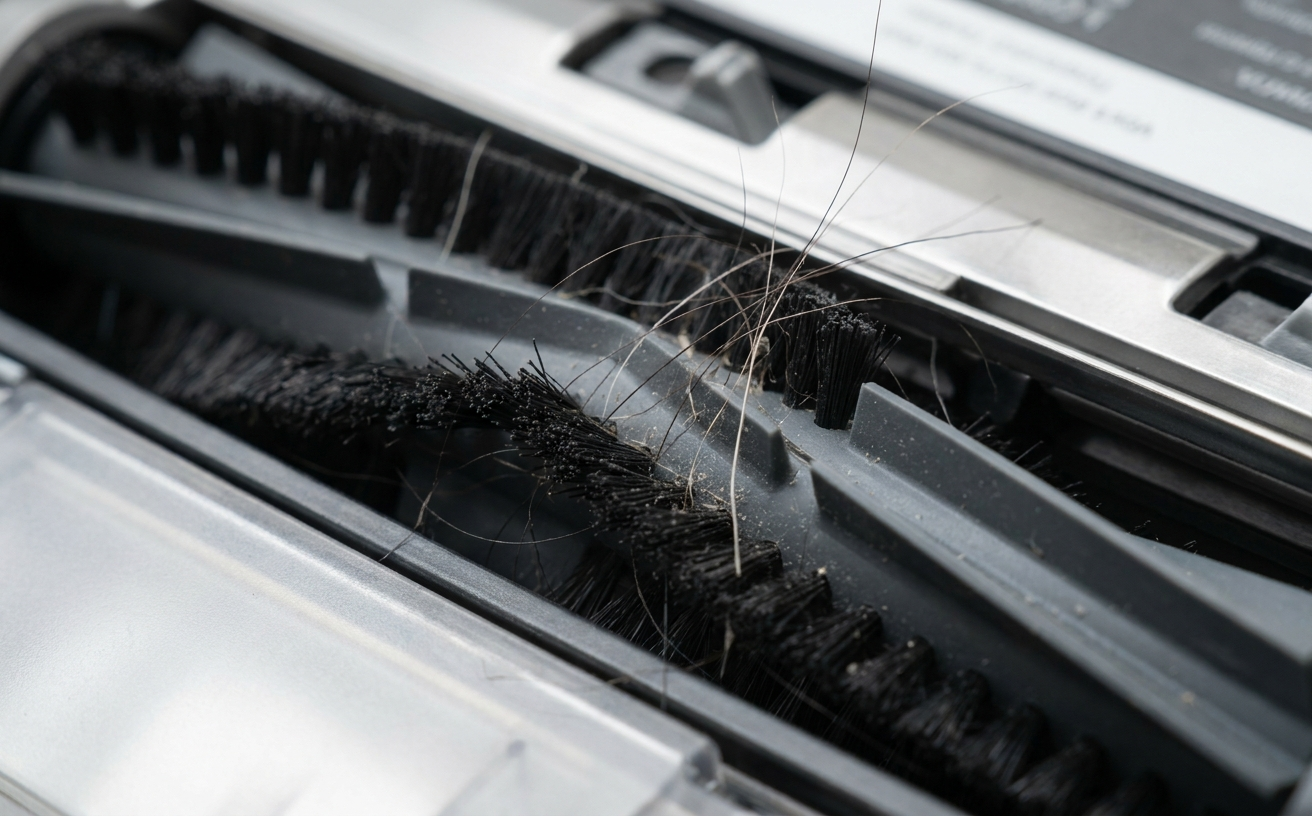
Anti-tangle roller brush designs direct hair into the dustbin rather than wrapping around the shaft
Mopping Functionality
Many robovacs now combine vacuuming and mopping in a single unit. The quality of mopping varies considerably across models.
Basic mopping involves dragging a damp cloth or disposable pad across the floor. This works for light dust and surface grime but has little effect on dried-on marks or sticky residue.
More capable designs use rotating mop pads that spin and press downward with measurable force, which is significantly more effective on stubborn stains. The best systems also lift the mop pads automatically when a carpet is detected, preventing wet mops from dampening carpet fibres.
If mopping is important to you, check both the mop design (spinning vs. dragging) and whether the machine can separate vacuuming and mopping into different passes. Some advanced models vacuum the entire floor first, then return specifically to mop hard floor zones.
Obstacle Avoidance
A robot vacuum that cannot reliably detect and avoid obstacles will get stuck, knock things over, or in worst cases, drag unpleasant debris (such as pet waste) across your floors.
Entry-level models use cliff sensors to avoid stairs and basic bump sensors to detect contact with objects. More advanced models add structured light sensors, front-facing cameras, or AI recognition to identify specific objects such as cables, shoes, and pet toys before contact.
The accuracy of obstacle avoidance matters most in busy households. If your floors tend to have phone chargers, children's toys, or pet items scattered around, a model with multi-sensor obstacle detection will handle daily cleaning more reliably.
Self-Emptying Docks and Maintenance
A self-emptying dock removes the debris from the robovac's onboard dustbin and stores it in a larger bag or container in the base station. This is the feature that genuinely reduces how often you need to interact with the machine. A standard dock requires emptying after every few cleans; a self-emptying station extends that to every few weeks.
For homes where mopping is part of the clean, base stations have also evolved to include automatic mop washing and drying. The machine returns to the dock mid-clean, washes the mop pads using clean water, then resumes. After the clean is done, the dock dries the mop pads using warm air, which prevents odour and mildew.
When comparing docks, consider these features:
- Auto dust emptying with a sealed bag (reduces allergen exposure when emptying)
- Onboard water supply and dirty water collection tanks
- Hot water mop washing for more thorough cleaning of the pads
- Warm air mop drying to prevent odour
- Auto refill of the robot's water tank for continuous mopping
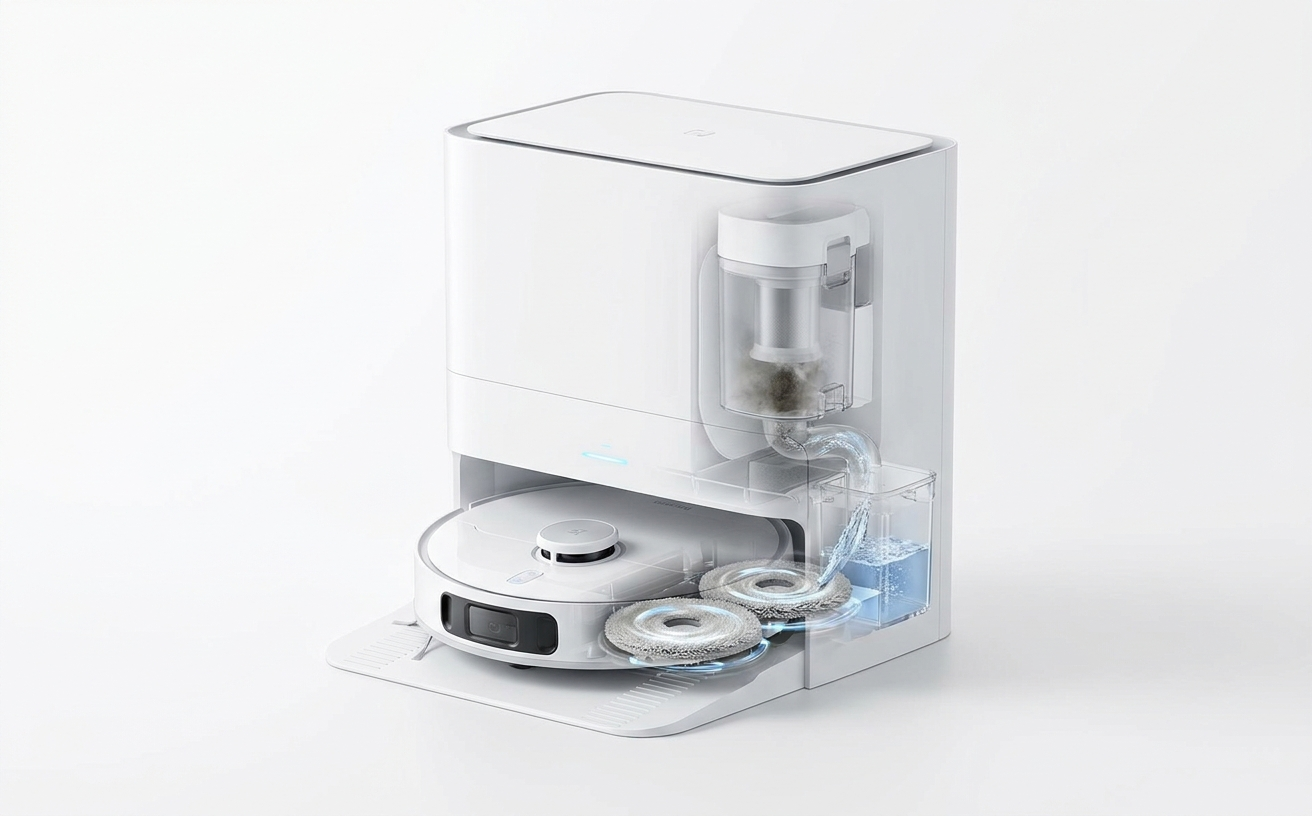
An all-in-one dock can empty the dustbin, wash mop pads, and dry them automatically
Battery Life and Coverage
Battery life determines how much floor area the robovac can cover in a single run. Most models list their coverage in square metres at standard suction, but actual results depend on your floor plan, furniture density, and the suction mode used.
Recharge and resume is a baseline feature to look for: if the battery runs low before the clean is finished, the robot returns to the dock, charges, and continues from where it left off.
A typical Australian home of 150 to 250 square metres will be handled without issue by most mid-range models. Larger homes or those with complex layouts or thick carpet should look for models with higher battery capacity or longer runtimes at high suction settings.
App Control and Smart Home Integration
All current robovacs connect to a smartphone app. At minimum, a good app lets you start and stop cleans, view the floor map, set no-go zones and room boundaries, adjust suction and mopping settings, and review clean history.
More capable apps allow per-room settings, scheduled cleans by zone, and detailed cleaning reports that show which areas were covered and how long was spent in each room. Some models also support voice control through Google Assistant, Amazon Alexa, or Siri.
If you plan to integrate the robovac into a smart home routine, check compatibility with your existing ecosystem before buying.
Choosing the Right Robovac for Your Home
The right robovac depends primarily on your floor mix, household, and how much maintenance you want to handle. Reading robot vacuum reviews alongside the spec sheet is the most reliable way to confirm a model performs in homes like yours.
Homes with Hard Floors and Light Carpet
A model with LiDAR navigation, 4,000 Pa or more of suction, and rotating mop pads will handle this combination well. The key mopping differentiator at this level is downward pressure: a mop pad pressing at 8N removes dried-on marks in a way that a dragging cloth cannot.
The Narwal Freo S robot vacuum and mop delivers 8,000 Pa of suction and 8N rotating mop pressure, with a 3.5L dust bag that holds up to 180 days of debris before you need to empty it. The dock self-empties automatically after each clean, so your main interaction is swapping the bag a few times a year.
[cta:narwal-freo-s-robot-vacuum-mop]
Homes with Pets and Long Hair
The weak point of most robot vacuums in this scenario is the brush, not the suction. Hair wraps around the roller, reduces pickup, and requires you to clear it by hand. The solution is a brush system that prevents tangling at the source rather than one that simply claims to be easy to clean.
The Narwal Freo X10 Pro robot vacuum and mop uses a DualFlow Tangle-Free System: the side brush automatically switches between a V-shape that captures hair and an II-shape that sheds it toward the roller, and the conical single-arm roller brush aerodynamically guides hair into the dustbin rather than wrapping around the shaft. Both are SGS-certified at 0% tangle rate with 99% hair removal. The 120-day self-emptying dock with 104°F warm air mop drying means the base station handles itself between bag changes.
[cta:narwal-freo-x10-pro-robot-vacuum-mop]
Homes with Mixed Floors and High Cleaning Standards
The challenge with mixed-floor mopping is that a dirty mop spreads grime rather than removing it. Most robot mops use a fixed damp pad that gets progressively more contaminated across a clean. The meaningful upgrade is a system that keeps the mop itself clean while it works.
The Narwal Flow robot vacuum and mop addresses this with its FlowWash system: 16 nozzles spray 45°C water across the track mop during each pass, a scraper strips the residue off, and the dirty water is extracted and separated before the mop makes another contact with the floor. The result is that the mop is clean for every pass rather than just the first. Suction reaches 22,000 Pa, and the mop lifts 12mm automatically on carpet detection to keep fibres dry. The base station sterilises using 80°C water and dries with 40°C warm air after each session.
[cta:narwal-flow-robot-vacuum-mop]
Large Homes or Multi-Storey Properties
Coverage and continuity are the priorities here. The robot needs enough battery to handle a large floor area at high suction, a navigation system that builds and stores accurate maps per level, and a base station capable of extended hands-free operation so you are not emptying or refilling between floors.
The Narwal Freo Z10 Ultra robot vacuum and mop covers this with 18,000 Pa suction, a 6,400 mAh battery, and LiDAR 4.0 navigation that builds a 3D multi-floor map in around six minutes per level. Its base station self-empties into a 2.5L bag that lasts 120 days, and washes mop pads with water that adjusts between 113°F for dust, 140°F for oil, and 167°F for a final sterilisation rinse, with no manual intervention required between sessions.
[cta:narwal-freo-z10-ultra-robot-vacuum-mop]
Once you've narrowed down the type of robot vacuum that suits your home, it's worth checking current robot vacuum deals in Australia before you buy, since flagship models often run promotional pricing around major sale periods.
FAQs
How often do I need to empty a self-emptying robovac?
This depends on the size of the base station's dust storage and how much debris your floors collect. Most self-emptying stations hold between four and ten weeks of debris before the bag or container needs to be emptied.
Can a robovac replace a regular vacuum?
For day-to-day maintenance on hard floors and low-pile carpet, yes. For deep cleaning thick carpet or clearing large debris, a cordless or upright vacuum remains useful as a supplement.
Do I need a robovac with mopping?
If your home has a mix of hard floors and you clean them regularly, a combo vacuum and mop unit with spinning mop pads can meaningfully reduce the time you spend mopping manually. If your home is mostly carpet, a vacuum-only model is simpler and equally capable.
Are robovacs suitable for pet hair on carpet?
Yes, provided you choose a model with anti-tangle brush design and sufficient suction. Look for certified tangle-free performance and suction of at least 4,000 Pa for low-pile carpet, or higher for medium-pile. A self-emptying dock with a sealed dust bag is also useful for keeping pet allergens contained.
How loud is a robot vacuum?
Most current robovacs run between 55 and 70 decibels in standard cleaning mode, comparable to a normal conversation or a dishwasher. Mopping mode is generally quieter than vacuuming. Self-emptying docks are louder during the brief emptying cycle, which is why some models schedule emptying immediately after the clean rather than mid-session.


