
Choosing the right robot vacuum cleaner in Australia depends on your floor type, home layout, and cleaning needs.
Choosing a robot vacuum cleaner in Australia comes down to matching four things to your home: suction power for your floor types, navigation for your layout, mopping capability for your cleaning standard, and dock features for how often you want to do maintenance. Get those four right, and the rest is preference.
Australian homes typically combine hard floors with carpet, often across multiple rooms or storeys, and many households deal with shedding pets, long hair, or door thresholds that older robots struggle to cross. The sections below cover the specifications that actually matter for those conditions.
Quick Match: Which Robot Vacuum Suits Your Home?
Use the scenarios below as a fast filter before reading further. Each line points to the features that matter most for that situation.
- Mostly hard floors with area rugs: 8,000–12,000 Pa suction, rotating or track mop, automatic mop lift.
- Carpeted bedrooms or living areas: 10,000 Pa+, automatic suction boost on carpet detection, 10 mm+ mop lift.
- Pets and long hair: Tangle-free roller brush, AI obstacle avoidance, larger sealed dust bag in the dock.
- Multi-storey home: LiDAR navigation with multi-floor mapping (3+ saved maps), strong threshold-crossing ability.
- Cluttered floors with cables and toys: AI camera-based obstacle recognition, 5 mm object detection precision.
How a Robot Vacuum Cleaner Works
A robot vacuum uses a combination of sensors, onboard computing, and motorised components to clean autonomously. During a first run, it maps your home and stores that layout for future use. On subsequent cleans, it follows planned routes rather than bouncing at random. For a deeper look at the internal mechanics, see how robotic automatic vacuums work.
Most modern units combine vacuuming with mopping in a single pass. The robot detects floor type and adjusts automatically: lifting the mop pad over carpet, increasing suction in carpeted zones, and returning to the dock to recharge and resume if the job takes longer than one battery cycle.
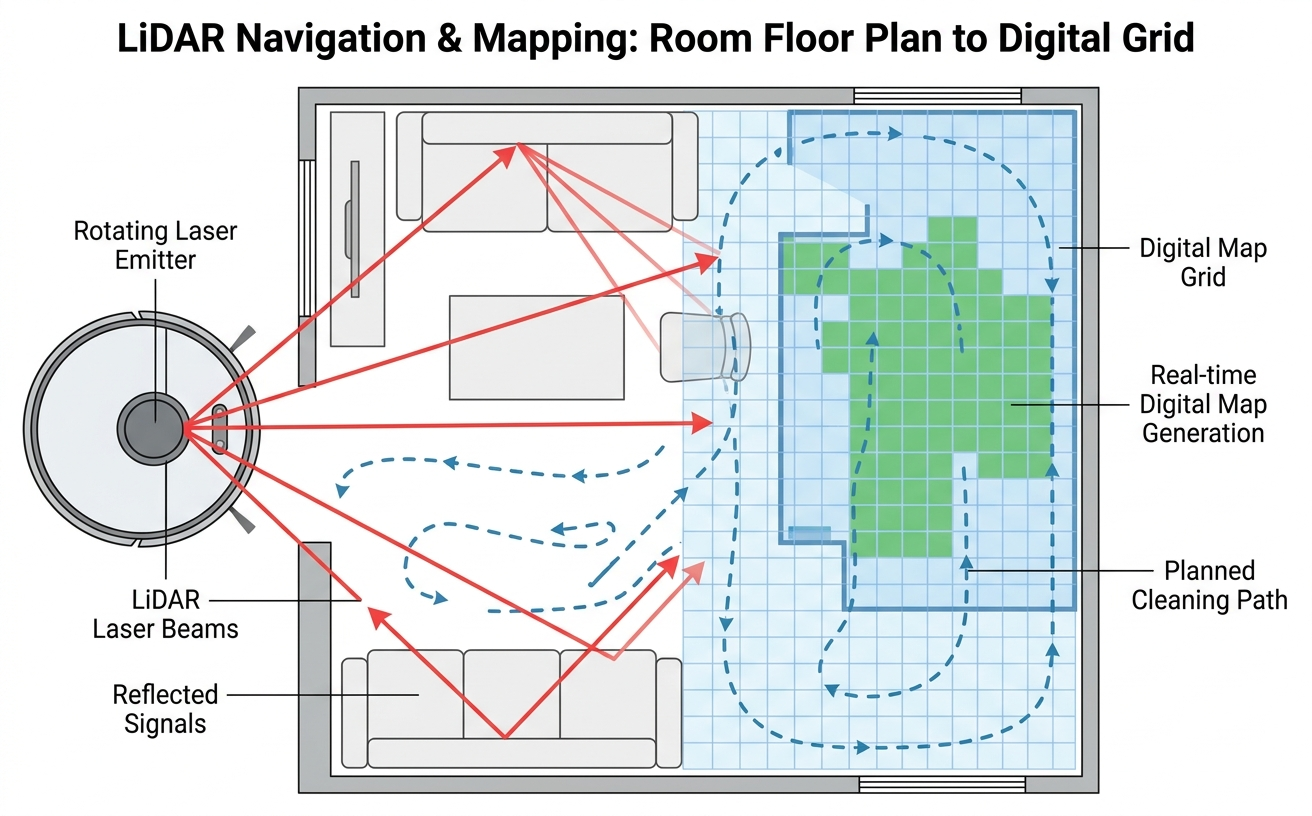
LiDAR navigation builds a precise room map that the robot uses to plan efficient, systematic cleaning routes.
Suction Power for Australian Homes
Suction is measured in Pascals (Pa). For Australian homes with a mix of hard floors and carpet, 6,000 Pa is a practical minimum that handles dust, crumbs, and pet hair reliably. Models above 10,000 Pa deliver noticeably better results on low-pile carpet and in tight crevices, though they tend to run louder.
Very high suction figures (18,000 Pa+) are most relevant if you have medium to high-pile carpet or dogs that shed heavily. For homes that are mostly hard floors with area rugs, 8,000 to 12,000 Pa is plenty, and you'll often see better real-world performance because the robot can run more quietly and conserve battery for a longer clean.
Navigation: LiDAR vs Camera-Based Systems
LiDAR is the navigation standard worth prioritising. The robot emits a rotating laser beam that maps the room in real time, building a precise floor plan it follows on every clean. The result is systematic, row-by-row coverage rather than random bouncing, and it works in complete darkness.
Camera-based navigation is common in more affordable models. It works well in daylight but can struggle in low-light conditions and tends to produce less efficient cleaning paths. Some newer flagship models pair LiDAR with RGB cameras, using the laser for mapping and the cameras for obstacle recognition.
Most mid-range and above models store between 3 and 10 saved maps, letting you carry the robot upstairs without remapping every time.
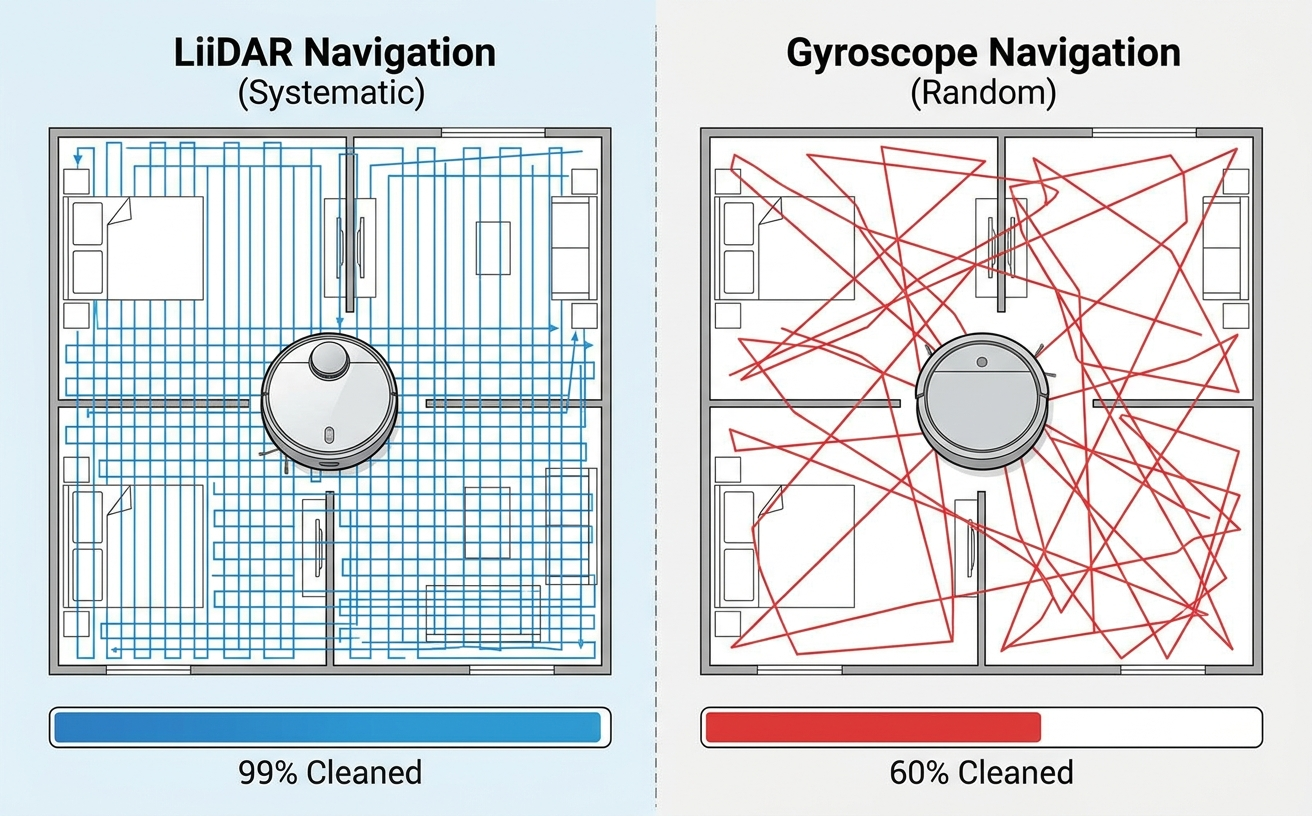
LiDAR navigation (left) covers rooms methodically. Random-path models (right) often miss sections and require multiple passes.
Obstacle Avoidance for Pet Owners and Cluttered Homes
Basic robots use cliff sensors and bumpers, which means they detect a drop or a collision only after it happens. This is fine for simple, clear rooms but falls short in homes with cables on the floor, scattered toys, or pets.
AI-based obstacle avoidance uses cameras and onboard processing to identify and navigate around specific objects before contact. Good systems recognise cables, shoes, pet bowls, and pet waste, avoiding them rather than dragging them across the floor. For households with pets or young children, this is one of the most practical upgrades available.
Precision matters too: look for systems that can detect objects as thin as 5 mm and as low as 5 mm from the floor.
Mopping Systems: Rotating, Track, and Vibrational
Vibrational or drag-style mop pads are the most common and least effective. They pass damp cloth over the surface without real scrubbing pressure, which handles light dust but leaves dried stains behind.
Rotating mop pads spin against the floor with downward pressure, similar to hand-scrubbing. Look for at least 180 RPM and at least 6N of downward pressure for consistent stain removal.
Track mop systems use a continuous belt that cycles through a self-cleaning rinse within the robot itself during the cleaning pass, so the mop stays clean rather than spreading dirty water across the floor. This approach is more effective on stubborn stains because the mop never gets progressively dirtier as it works.
For homes with grout lines, textured tiles, or surfaces prone to dried spills, rotating pads or track mops will outperform basic vibrational systems considerably.
Carpet Performance and Pet Hair
A robot that handles both hard floors and carpet well needs automatic mop lifting (at least 10 mm clearance) to keep the carpet dry during mopping passes, plus a suction boost when it crosses onto carpet.
For low-pile carpet (under 10 mm), most mid-range robots with 6,000 Pa or above perform reliably. For medium-pile carpet (10 to 20 mm), look for models that actively increase airflow when carpet is detected. High-pile carpet above 20 mm is generally outside the effective range of robot vacuums, which struggle to navigate it without getting stuck.
Tangle-free roller brush systems are especially relevant for carpeted homes with long hair or pet fur. Standard rubber or bristle brushes wrap hair and require regular manual clearing. Floating, conical brush designs release hair into the dustbin rather than winding it around the brush axle.
Self-Emptying and Self-Cleaning Docks
A self-emptying dock automatically suctions dust from the robot's bin into a sealed bag in the base station after each clean. Bag capacity typically ranges from 1 to 3.5 litres, with some lasting up to 180 days before requiring a swap. For most households, this is the single biggest quality-of-life upgrade over a standard dock.
Self-cleaning docks go further by washing and drying the mop pads automatically. After a mopping session, the robot returns to the dock, which runs the pads through a wash and dry cycle. This eliminates the need to hand-rinse mop pads after every use and prevents the mould and odour that come from leaving damp pads sitting.
Hot-water mop washing is a meaningful step beyond cold rinse. Water at 60 to 80 degrees Celsius dissolves grease and stubborn residue that cold water leaves behind, and at the higher end, provides a sterilising rinse that cold water can't match.
Filtration is worth checking at the dock level too. Sealed bags and HEPA-grade filters keep fine dust and allergens contained during disposal, which matters during pollen season or in homes with allergy sufferers.
When comparing docks, look at the wash temperature, whether drying is hot air or ambient, and how long the dry cycle runs. Incomplete drying leaves the pads damp and creates odour over time.
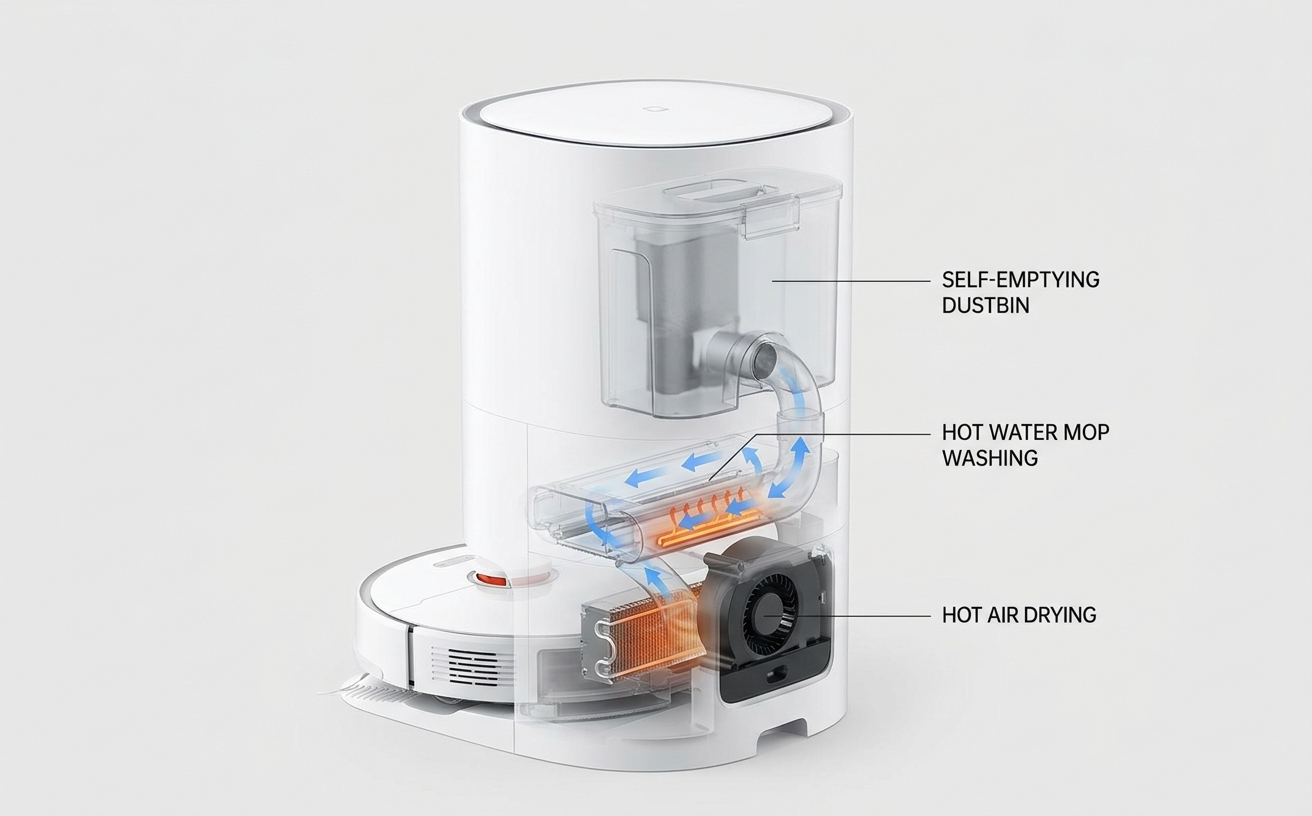
All-in-one base stations handle emptying, mop washing, drying, and recharging automatically, reducing hands-on maintenance.
Threshold and Door Sill Crossing
Australian homes commonly have thresholds between rooms, sliding door tracks to the patio, and raised transitions between tile and carpet. A robot vacuum needs to clear these to clean continuously rather than getting stranded in one zone.
Most mid-range models clear thresholds up to 20 mm. Higher-end models with adaptive drive systems can cross 30 to 40 mm, including standard sliding door tracks. Measure your tallest threshold before buying and check the manufacturer's stated maximum, since being even 5 mm short means a manual lift every time.
What to Check Before Buying in Australia
Beyond the core specs, a few practical details specific to the Australian market can affect whether a purchase goes smoothly. These apply regardless of which brand or model you're considering.
Buying from an Australian retailer or the brand's AU website matters for several practical reasons. Grey-market stock often arrives with overseas power adapters, and warranty claims require return shipping to the country of sale.
Check that the model you're buying includes a local manufacturer's warranty (typically two years for reputable brands) and that customer support is accessible from Australia.
Wi-Fi Compatibility
Most robot vacuums connect to 2.4 GHz Wi-Fi only. If your router is set to 5 GHz by default or uses a combined band, you may need to switch the relevant band to 2.4 GHz or split the networks to get the robot connected. Check your router settings before assuming there's a fault with the unit.
Floor Type and Home Layout
A single-storey home with mostly hard floors and some carpet has different requirements to a two-storey home with carpet throughout. Multi-floor mapping, mop lift height, and carpet suction boost all become more relevant as the home gets more complex.
For open-plan homes with clear paths and minimal clutter, basic obstacle avoidance is usually sufficient. For homes with cables on the floor, young children, or pets, AI-based object recognition saves significant frustration.
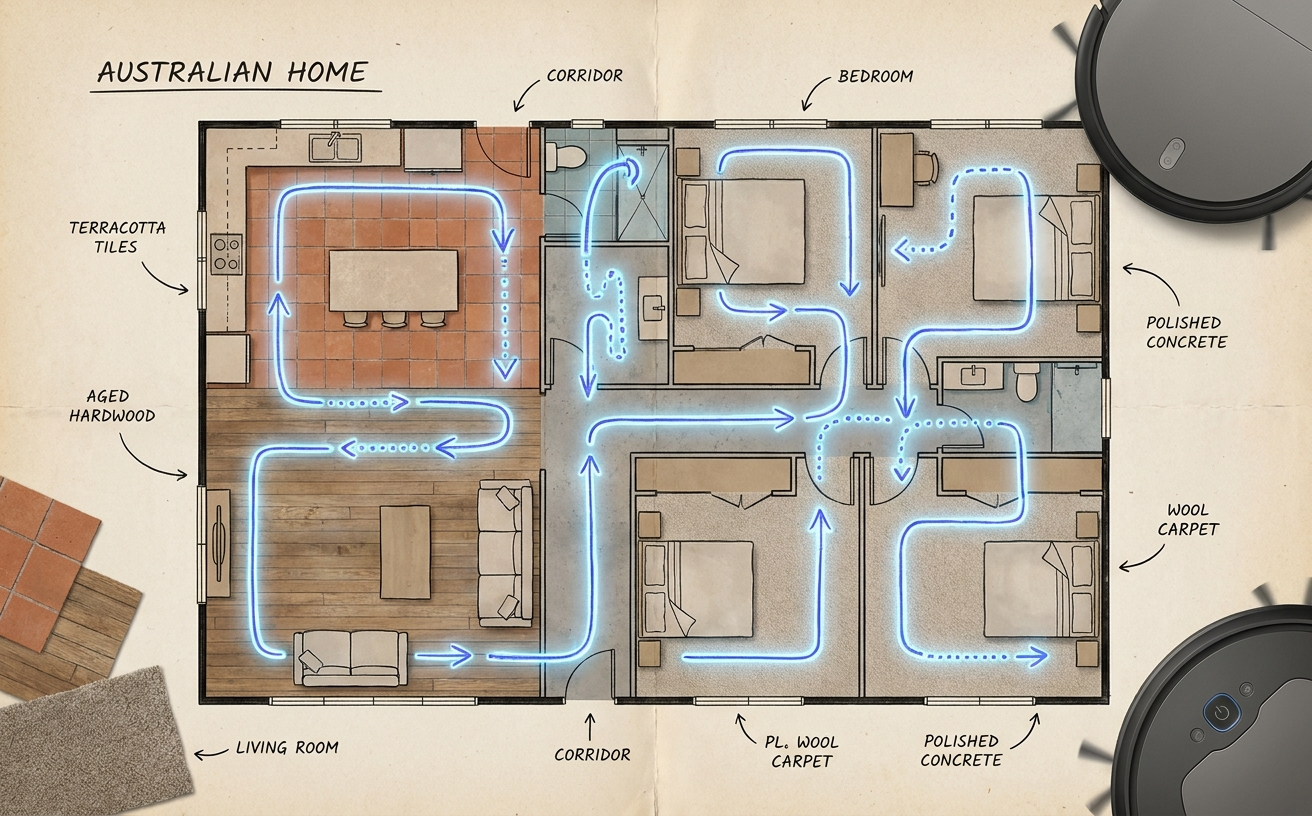
Mixed-floor Australian homes benefit from robots that automatically adjust suction and mop height between surface types.
Noise Levels
Vacuum mode typically runs between 60 and 75 dB, which is similar to a conversation or a running dishwasher. If you plan to run the robot overnight or while working from home, look for models that offer a quiet or eco mode and check the base station dB rating separately, as self-emptying and washing cycles can be louder than the robot itself.
Narwal Robot Vacuum Cleaners Available in Australia
Narwal is available in Australia through Narwal Australia, Amazon AU, Costco AU, and Harvey Norman. All Australian-stocked models come with a 2-year local manufacturer's warranty, Australian-compatible power adapters, and access to lifetime customer support. Returns are accepted within 30 days, and free shipping applies to orders over $100.
The table below summarises the current Narwal range available in Australia.
| Model | Suction | Key Strength | Best For |
|---|---|---|---|
| Narwal Flow | 22,000 Pa | Real-time self-cleaning track mop, dual-camera AI avoidance | Whole-home cleaning, families with pets and kids |
| Narwal Freo Z10 Ultra | 18,000 Pa | LiDAR 4.0, EdgeReach triangular mop, hot mop wash up to 167°F | Edge and corner cleaning, multi-storey homes |
| Narwal Freo X10 Pro | 11,000 Pa | DualFlow tangle-free system, MopExtend, 120-day dock | Households with long hair or pets |
| Narwal Freo Z10 | Not stated | Triangular mop, DirtSense 3.0, 6-in-1 dock with 45–75°C wash | Mixed-floor homes wanting a quiet daily clean |
| Narwal Freo S | 8,000 Pa | 180-day dust storage, 8N rotating mop, LDS LiDAR | Hard-floor homes prioritising long-interval maintenance |
Narwal Flow
The Narwal Flow is Narwal's flagship robot vacuum and mop, built around a track mop system that self-cleans in real time during the cleaning pass. Rather than carrying the same dirty mop across the floor, the FlowWash system rinses and scrapes the mop continuously with warm water at 113°F (45°C), so each pass applies a clean surface to the floor.
It runs 22,000 Pa suction and uses dual 136° RGB cameras with an onboard AI chip to detect and avoid over 200 types of obstacles with precision down to 0.19 inches, including cables, small objects, and pet accidents. The CarpetFocus system actively lowers the brush cover on carpet to create a sealed airflow zone, and the mop lifts to 12 mm automatically to keep carpet dry.
The all-in-one dock handles 120 days of dust storage, AI-adaptive hot water mop washing at up to 176°F (80°C) for sterilisation, and warm air drying at 104°F (40°C). The DualFlow tangle-free system is SGS-certified for a 0% hair tangling rate across animal hair, human hair, carpet fibres, and other materials.
[cta:narwal-flow-robot-vacuum-mop]
Narwal Freo X10 Pro
The Narwal Freo X10 Pro is a robot vacuum and mop built around the DualFlow tangle-free system, which combines a dynamic auto-detangling side brush with a conical zero-tangling floating roller brush. The side brush switches between V-shape and II-shape positions to release wrapped hair, and the cone-shaped roller channels hair directly into the dustbin. Both are SGS-certified for a 0% tangling rate.
It delivers 11,000 Pa suction with millimetre-precise obstacle avoidance, recognising objects as low as 1 cm and cleaning along edges within 5 mm. The MopExtend system extends and swings a Reuleaux triangular mop with 8N downward pressure and 180 RPM rotation, providing a 10 mm wider cleaning path than circular mops to reach toe-kicks, corners, and tight edges.
The all-in-one dock self-empties, washes, and dries the mop pads automatically, providing up to 120 days of hands-free operation. This model is a practical fit for households with long hair or pets, where roller brush maintenance is a persistent issue.
[cta:narwal-freo-x10-pro-robot-vacuum-mop]
Narwal Freo Z10 Ultra
The Narwal Freo Z10 Ultra is a robot vacuum and mop with 18,000 Pa suction and LiDAR 4.0 navigation that builds a detailed 4-layer 3D map in around 6 minutes. Its TUV-certified EdgeReach triangular mop extends and twists with 8N downward pressure to reach wall edges and corners that standard circular mops miss.
The base station self-empties into a 2.5L bag lasting up to 120 days and washes mop pads using temperature-adaptive hot water: 113°F for general cleaning, 140°F for oil, and up to 167°F for a deep sterilising rinse. The robot separates wet and dry waste internally for cleaner disposal. Voice control works with Alexa, Siri, and Google Home.
[cta:narwal-freo-z10-ultra-robot-vacuum-mop]
Narwal Freo Z10
The Narwal Freo Z10 is a robot vacuum and mop built around a triangular mop with 8N downward pressure that dynamically extends to handle furniture edges, walls, and corners, then retracts when turning or crossing obstacles. The DualFlow tangle-free system pairs a dynamic V-to-II side brush with a zero-tangling floating roller, both SGS-certified, to handle long hair and pet fur.
DirtSense 3.0 detects how dirty an area is and adjusts the number of re-wash and re-mop passes automatically, mopping until the floor is clean rather than completing a fixed number of cycles. The robot recognises objects as low as 1 cm and cleans along edges within 5 mm using front and side sensors. Hard-floor particle removal is rated at 99% or higher.
The 6-in-1 base station handles automatic detergent dispensing, dynamic 45 to 75°C hot water mop washing, 40°C warm air drying, dust compression into a 1L antibacterial bag rated for 120 days, and automatic water exchange. Operating noise is rated at 56 dB or lower in vacuum and mop modes, suitable for running while working from home.
[cta:narwal-freo-z10-robot-vacuum-mop]
Narwal Freo S
The Narwal Freo S is a robot vacuum and mop with 8,000 Pa suction across four power modes, including automatic Carpet Boost when it detects carpet. The mop applies 8N of downward pressure with three adjustable water flow settings and a 300 ml removable tank.
Navigation uses LDS LiDAR with structured-light obstacle detection, supporting multi-floor mapping, no-go zones, and 360° room recognition. It crosses thresholds up to 20 mm and runs at 62 dB or below in vacuum mode and 60 dB or below in mop mode.
The standout feature is the dock's 3.5L sealed antibacterial dust bag, rated for up to 180 days of hands-free operation, which is longer than most models in the category. Voice control works with Google Home and Alexa. This model suits hard-floor homes that prioritise long maintenance intervals over flagship-tier specifications.
[cta:narwal-freo-s-robot-vacuum-mop]
FAQs
What suction power do I need for Australian homes?
For hard floors with light to moderate dust and debris, 6,000 Pa is adequate. For homes with carpet, particularly medium-pile, 10,000 Pa or above with automatic carpet detection gives more consistent results. Pet owners with multiple animals shedding heavily are best served by the higher end of the range, where the robot can maintain coverage without slowing down on dense debris.
Can robot vacuums handle Australian pet hair?
Yes, but brush design matters more than suction alone. Standard bristle roller brushes tangle with dog and cat fur and require frequent manual clearing. Conical or floating single-arm brush designs, particularly those with tangle-free certification, handle pet hair considerably better and reduce maintenance significantly.
Do robot vacuums work on thick Australian rugs?
Most robot vacuums work reliably on low-pile carpet and thin area rugs. On medium-pile carpet (10 to 20 mm), performance varies by model. High-pile rugs above 20 mm generally cause navigation issues and the robot may get stuck or avoid those areas. Check the stated maximum carpet height in the specifications before buying.
Do I need both a robot vacuum and a cordless stick vacuum?
Many Australian households use both. The robot handles routine floor cleaning automatically, while a cordless stick vacuum covers the surfaces a robot can't reach: stairs, sofas, mattresses, car seats, and high shelves. If your home has multiple storeys or significant upholstered furniture, owning both is a more complete setup than either alone.
What's the difference between a self-emptying and a self-cleaning dock?
A self-emptying dock suctions dust from the robot's bin into a bag in the base station, extending the time before you need to touch the dustbin. A self-cleaning dock also washes and dries the mop pads automatically after each mopping session. The two functions are distinct: some docks offer only one, while all-in-one stations handle both emptying and mop cleaning in the same unit.


