
The ECOVACS OZMO system brought integrated mopping to robot vacuums, but the technology has evolved significantly since 2017.
The ECOVACS OZMO mopping system is an integrated vacuum-and-mop technology built into DEEBOT robot vacuums. First introduced in 2017, it uses an electronically controlled water pump and microfibre cloth to mop hard floors while vacuuming in a single pass. The system has gone through several generations, from the original OZMO pad to the OZMO Pro vibrating plate and the current OZMO Roller design that washes its own mop during cleaning. If you are new to how robot vacuum and mop combos work, the core idea is the same across brands: one robot handles both vacuuming and wet mopping in a single session.
OZMO remains a common search term in Australia because ECOVACS DEEBOTs are widely sold through JB Hi-Fi, Harvey Norman, The Good Guys, and Amazon AU. But the robot vacuum market has moved well beyond the original OZMO concept. Competing brands now offer real-time self-cleaning mops, hot-water wash stations, and track-style mopping systems that address the limitations earlier OZMO versions could not.
What Is the ECOVACS OZMO Mopping System?
At its core, OZMO pairs an electronically controlled water pump with a mopping surface on the underside of the robot. The pump feeds water at a user-adjustable flow rate, and a microfibre pad or roller cleans the floor behind or beneath the vacuum module. The electronic pump is a step above older gravity-fed systems, which tend to over-wet floors when the robot pauses or drip during tank removal. With OZMO, water delivery stops when the robot stops. Flow level is adjustable through the ECOVACS HOME app across four settings.
Automatic carpet detection is consistent across OZMO-equipped DEEBOTs. When the robot detects a carpet using ultrasonic or infrared sensors, it stops water delivery and, on newer models, lifts the mop to avoid wetting carpet fibres.
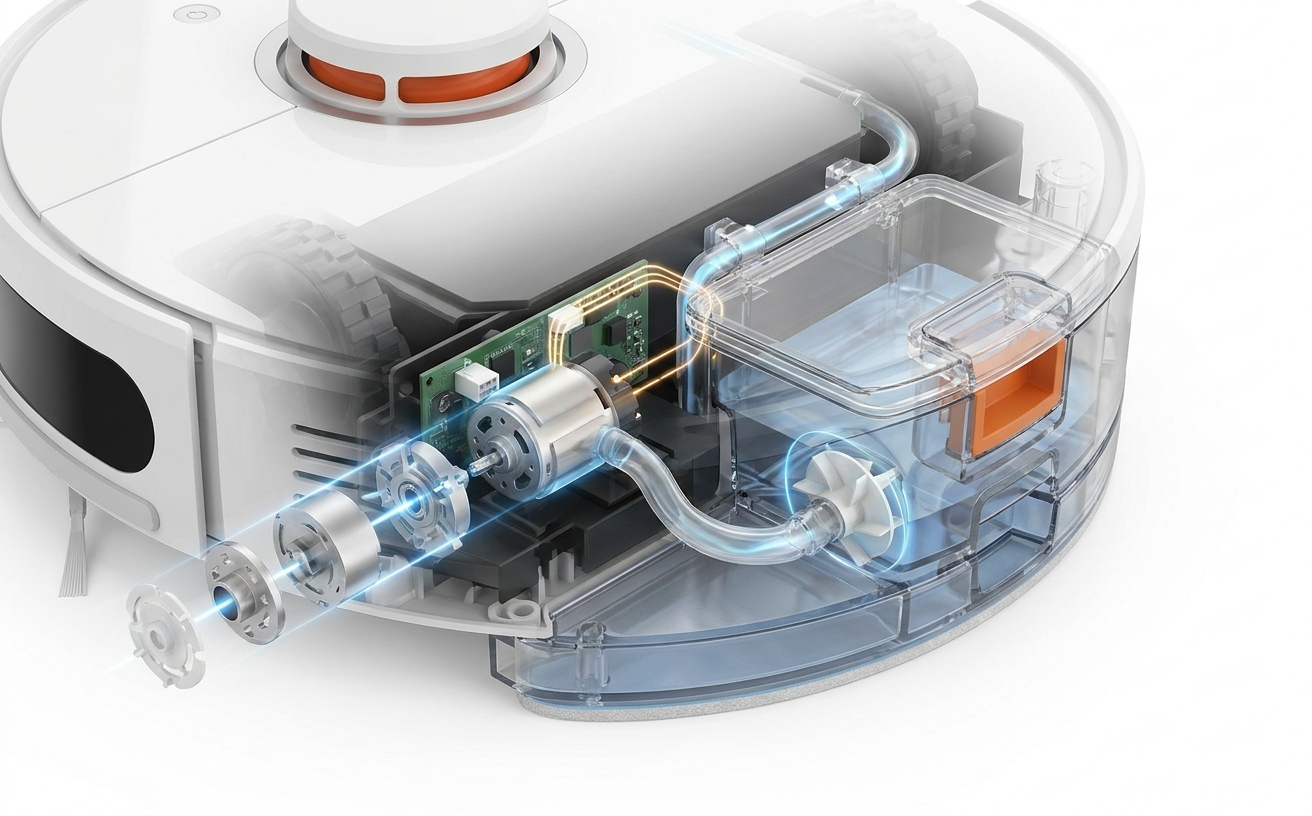
Electronic water pumps give OZMO-equipped robots precise control over water flow, preventing the over-wetting common in gravity-fed systems.
OZMO Mopping Generations: Original, Pro, Turbo, and Roller
OZMO is not a single mopping system. It is a technology label that has covered four distinct approaches across different DEEBOT models, each with different cleaning performance and maintenance demands.
OZMO (Original)
The original OZMO, launched on the DEEBOT OZMO 930 in 2017, paired a 240 mL water tank with a passive microfibre pad. The robot dragged the damp pad across the floor while vacuuming. Water flow was electronically controlled, but the pad had no active scrubbing mechanism. It handled light dust and surface-level grime, but dried-on stains or sticky residues were beyond its capability.
OZMO Pro
Released in 2020 as an add-on for the DEEBOT T8 series, OZMO Pro introduced a vibrating mop plate that oscillated at up to 480 times per minute. The vibration added genuine scrubbing force, making it noticeably more effective on dried spills and pet prints. The 240 mL tank and electronic pump carried over.
OZMO Turbo
OZMO Turbo uses dual spinning mop pads that rotate at high speed. This design appeared across many mid-range and high-end T-series DEEBOTs and delivers stronger mechanical agitation than the original OZMO or OZMO Pro. Models with OZMO Turbo typically lift the mop pads 9 to 12 mm when transitioning onto carpet.
OZMO Roller (2.0 and 3.0)
The OZMO Roller replaced pads with a rotating microfibre roller that continuously self-washes during operation. Clean water sprays onto the roller through multiple nozzles while a scraper strips dirty water into an onboard waste tank.
OZMO Roller 2.0, found on models like the DEEBOT T80S OMNI, generates up to 3,800 Pa of mopping pressure at 220 RPM. OZMO Roller 3.0, available on the T90 PRO OMNI and X12 OmniCyclone, extends the roller to 27 cm for wider coverage and adds FocusJet stain pre-treatment on the X12. Roller-equipped models also handle wet spills and liquid messes that pad-based systems struggle with, because the squeegee captures waste water in real time.
OZMO generations at a glance:
| Generation | Mopping Method | Self-Cleaning | Scrubbing Force | Example Models |
|---|---|---|---|---|
| OZMO (Original) | Passive drag pad | No | None | OZMO 930, N8 Pro |
| OZMO Pro | Vibrating plate | No | 480 vibrations/min | T8, T8 AIVI (add-on) |
| OZMO Turbo | Dual spinning pads | At dock only | High-speed rotation | T30S, T20, T50 series |
| OZMO Roller 2.0 | Self-washing roller | During cleaning | 3,800 Pa at 220 RPM | T80S OMNI, T80 OMNI |
| OZMO Roller 3.0 | Extended self-washing roller | During cleaning | 27 cm roller, FocusJet | T90 PRO OMNI, X12 |
OZMO Mopping Limitations and Common Complaints
Each OZMO generation improved on the last, but the system still carries trade-offs that affect real-world cleaning results. The issues below apply to different degrees depending on which OZMO version a DEEBOT uses.
Pad-based OZMO models (the original, Pro, and Turbo variants) share a fundamental problem: the mop surface gets progressively dirtier as it cleans. In a 100-square-metre home, the robot is effectively spreading diluted dirty water across the last rooms it enters. The OZMO Roller mitigates this with continuous rinsing, but the older pad systems do not.
OMNI docking stations on newer ECOVACS models wash the mop with hot water (up to 75°C on top-tier models) and dry it with hot air after the cleaning run. This is a strong post-clean hygiene measure, but it does not change what happens during the session on pad-based models.
Edge and corner coverage has been a recurring limitation. ECOVACS has responded with TruEdge technology, extending the roller or mop pad closer to walls. On Roller 3.0 models, the roller extends about 1.5 cm beyond the robot's body. Robots using extending triangular mops or track-style mopping systems can reach tighter gaps along skirting boards and furniture legs.
A common complaint among DEEBOT owners is that mopping performance degrades over time or that the robot leaves streaks and an unpleasant smell after cleaning. In most cases, this traces back to the mop pad or roller not being cleaned thoroughly enough between sessions, or the drying cycle not fully removing moisture before the next use. Pad-based models are especially prone to this because the pad sits damp in the dock until the wash cycle runs. Robots with higher-temperature mop washing (above 60°C) and active hot-air drying tend to reduce odour buildup significantly. Models that rinse the mop during operation, rather than only at the dock, avoid the streaking issue almost entirely.
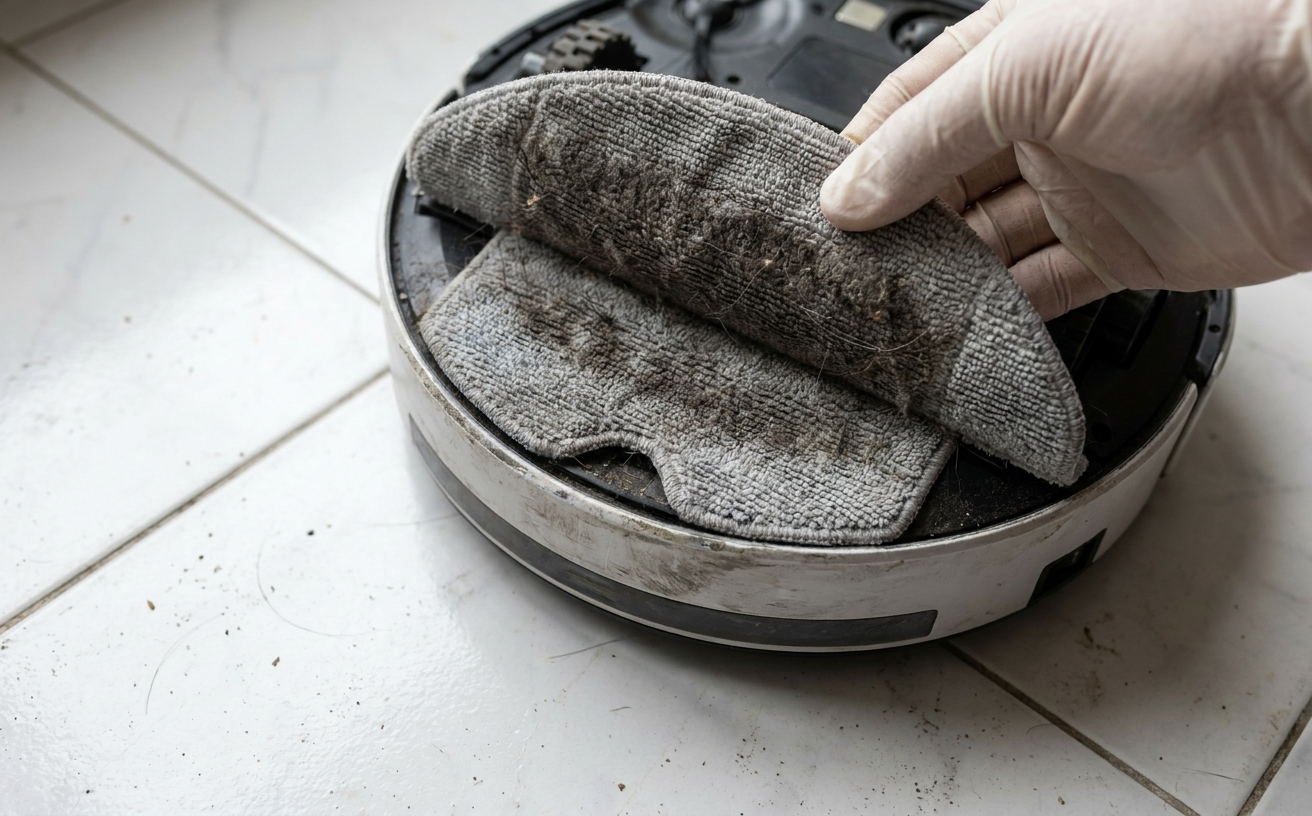
Pad-based mopping systems accumulate dirt throughout a cleaning run, reducing effectiveness in larger homes.
How Narwal Robot Mops Compare to OZMO
Narwal's robot vacuums use a fundamentally different mopping architecture. The two models most directly relevant to OZMO comparisons are the Narwal Flow and the Narwal Freo X10 Pro, each solving the mop-freshness problem through a different mechanism.
The Narwal Flow robot vacuum and mop uses a FlowWash track mop system. Sixteen nozzles spray 113°F (45°C) warm water onto the track mop while a scraper continuously removes dirty residue. The mop applies 12 N of consistent downward pressure as it cleans. The robot carries a dual onboard water tank, separating clean and waste water so the mop is always rinsed with fresh water. Suction reaches 22,000 Pa for vacuuming.
[cta:narwal-flow-robot-vacuum-mop]
Where FlowWash differs most from the OZMO Roller is in stain detection and response. The Narwal Flow's dual RGB cameras and onboard AI chip identify over 200 types of objects and recognise heavy stains. When it spots a stubborn mark, it reverses direction and re-cleans the area automatically. Current OZMO Roller models follow a fixed cleaning path regardless of stain severity. The Narwal Flow's track mop also extends to within 5 mm of walls, compared to TruEdge 3.0's approximately 1.5 cm gap, and its reversing side brush achieves 100% corner coverage in Narwal's lab testing.
The Narwal Flow's base station uses 176°F (80°C) hot water to clean the mop, internal pipes, and water tank after each session, followed by 104°F (40°C) warm-air drying at just 39 dB. That wash temperature exceeds the 75°C maximum on ECOVACS' top-tier OMNI stations, and the low drying noise makes it practical to run after every clean, including overnight.
The Narwal Freo X10 Pro robot vacuum and mop takes a different approach. Its Reuleaux triangular mop extends beyond the robot's body to reach within millimetres of walls and skirting boards. With 8 N of downward pressure and 180 RPM rotation, it scrubs dried-on stains that drag-style pads would glide over. The Freo X10 Pro's base station handles mop washing with 104°F hot air drying, and the 120-day self-empty dock means the dustbin rarely needs attention.
[cta:narwal-freo-x10-pro-robot-vacuum-mop]
Both Narwal models include automatic carpet detection with 12 mm mop lifting, DualFlow tangle-free brush systems verified by SGS at 0% hair tangling rate, and full app control through the Narwal app.
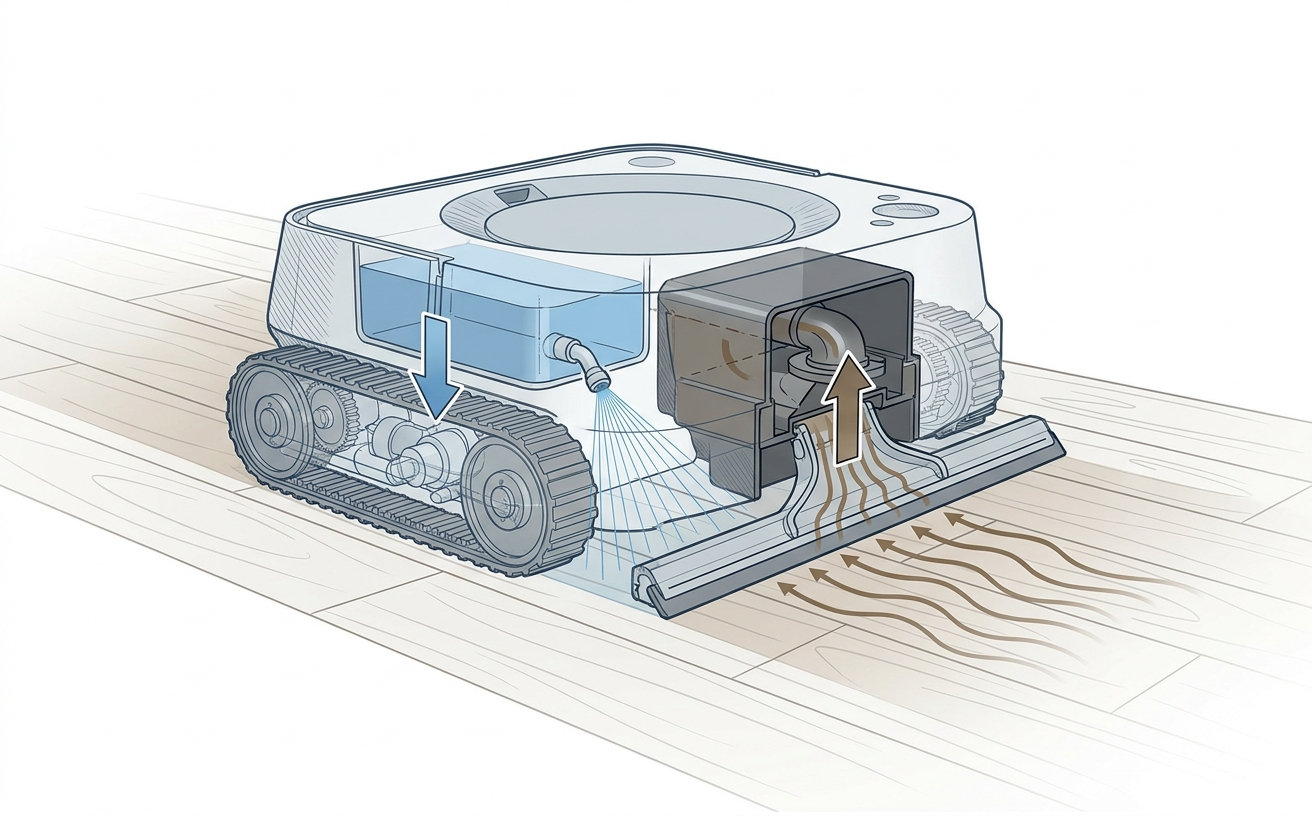
Track-style mopping systems spray fresh water and extract waste simultaneously, keeping the mop clean throughout the entire session.
What to Look for in a Mopping Robot Vacuum
Suction power, navigation, and obstacle avoidance have largely converged across brands at similar price points. The mopping system is where meaningful differences remain: how the mop stays clean during operation, how much pressure it applies, and how close it reaches to edges and corners.
Homes with mixed tiles, timber, and carpet across open-plan living areas need a robot that transitions between surfaces without manual intervention. Automatic mop lifting of at least 12 mm prevents carpet from getting damp during a mixed-surface clean.
For pet owners, anti-tangle performance matters as much as mopping quality. SGS-certified 0% hair tangling (available on Narwal Flow and Narwal Freo X10 Pro) reduces the maintenance that otherwise interrupts cleaning sessions. Self-empty docks with 120-day dust storage and hot-water mop washing with warm-air drying round out the features that reduce ongoing effort, particularly through humid Australian summers.

Australian open-plan homes with mixed flooring need robot vacuums that transition between surfaces automatically.
ECOVACS OZMO Models Available in Australia
The Australian ECOVACS lineup has shifted strongly toward Roller-based mopping. Not all OZMO-labelled models use the same mopping system, so confirming the exact OZMO generation matters before purchase.
DEEBOT T90 PRO OMNI (A$2,299 RRP) uses OZMO Roller 3.0 with a 27 cm extended roller, 30,000 Pa suction, and PowerBoost charging for large homes. Available at JB Hi-Fi, Harvey Norman, The Good Guys, and Amazon AU.
DEEBOT T80S OMNI (A$1,799) uses OZMO Roller 2.0 with 3,800 Pa mopping pressure at 220 RPM and TruEdge 3.0 edge cleaning. The most accessible Roller-equipped DEEBOT currently in Australia.
DEEBOT X8 MAX PRO OMNI (A$2,599 RRP, launched at A$1,599) pairs OZMO Roller with 16,600 Pa BLAST suction and ZeroTangle 3.0. Sold through Amazon AU and ecovacs.com/au.
Several older Turbo and pad-based models remain in circulation through clearance channels and secondhand markets. These use earlier OZMO generations with significantly different mopping performance.
FAQs
What does OZMO mean?
OZMO is a branded technology name created by ECOVACS. The company has not publicly defined it as an acronym. ECOVACS uses it as an umbrella label for all mopping systems built into its DEEBOT robot vacuums, from the original passive pad to the current self-washing Roller designs.
Can I use the OZMO mopping system without vacuuming at the same time?
Most OZMO-equipped DEEBOTs allow mop-only mode through the ECOVACS HOME app. This disables the vacuum motor and runs only the mopping function, useful for quick mop-ups on already-vacuumed floors.
How often should the OZMO mop pad or roller be replaced?
Reusable mop pads on older OZMO models typically need washing after every one to two uses and replacing every two to three months. OZMO Roller models use a microfibre roller that should be inspected monthly and replaced when cleaning performance drops, usually every three to six months.
What can I control through the ECOVACS app for OZMO mopping?
The ECOVACS HOME app lets you adjust water flow level (four settings), set no-mop zones on the map, schedule mopping sessions, choose between vacuum-only, mop-only, or combined modes, and on newer models, trigger the dock's mop washing and drying cycle remotely.
Why does my DEEBOT smell after mopping?
The most common cause is residual moisture in the mop pad or roller after cleaning. If the drying cycle is too short or the ambient humidity is high, bacteria grow on the damp surface and produce odour. Running the hot-air drying cycle immediately after each clean, and replacing pads or rollers on schedule, reduces this. Robots with higher wash temperatures (above 60°C) and longer drying cycles are less prone to the issue.


