
Dog urine on carpet is one of the toughest odours to remove — but the right method makes all the difference.
Dog urine smell does not go away with a quick wipe. The odour comes from uric acid crystals left behind after the liquid evaporates, and unless those crystals are broken down at a chemical level, the smell keeps coming back — and so does your dog, who can detect the scent long after you cannot.
Why Dog Urine Smell Is So Hard to Eliminate
Fresh dog urine contains water, ammonia, bacteria, hormones, and uric acid. The water and ammonia evaporate quickly, which is why the smell seems to fade at first. What remains are uric acid crystals that bond tightly to fibres in carpet, grout, and timber. These crystals are not water-soluble, meaning mopping or steam cleaning alone will not remove them.
Humidity reactivates the crystals. On warm, humid days common across much of Australia, old stains that seemed gone can suddenly smell strong again. That reactivation is the main reason standard household cleaners — particularly those based on ammonia or bleach — fail to permanently eliminate dog urine odour.
Leaving urine untreated has consequences beyond the smell. Uric acid crystals stay odour-active for months or years, and the lingering scent signals to your dog that the spot is an acceptable toilet area, leading to repeat marking. On hardwood, untreated urine seeps into the grain and can cause permanent dark stains and warping. On carpet, it soaks into the underlay and may eventually reach the subfloor, where the only solution becomes replacement.
What You Need Before You Start
Gather these before treating any area:
- Enzyme-based cleaner (the most effective option for breaking down uric acid)
- White vinegar (plain, not apple cider)
- Bicarbonate of soda (baking soda)
- 3% hydrogen peroxide
- Dishwashing liquid
- Clean white cloths or thick paper towels
- UV blacklight torch (essential for finding dried or hidden stains)
- Spray bottle
- Cold water — never hot, which can set the smell permanently into fibres
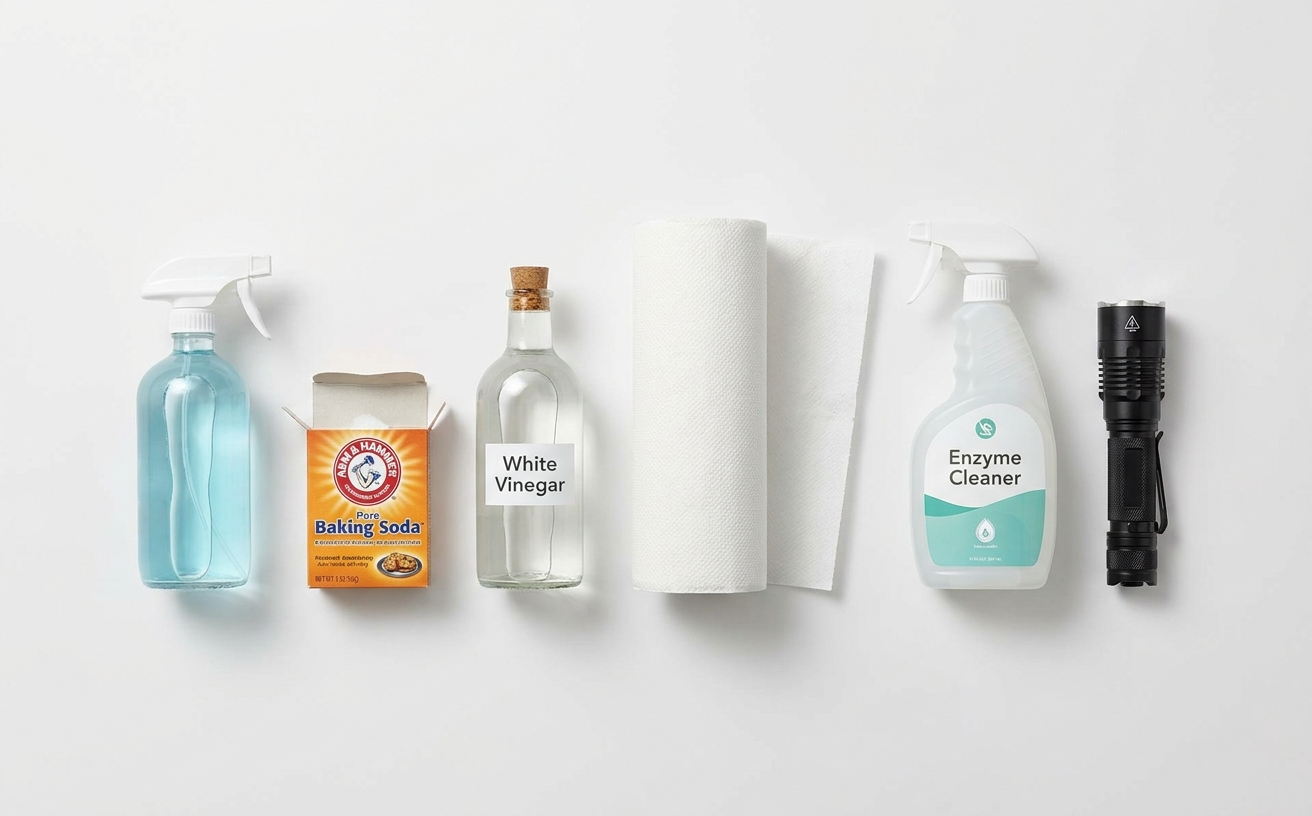
Gather your supplies before you start: enzyme cleaner, bicarbonate of soda, white vinegar, and a UV torch for finding hidden stains.
What Not to Eliminate Dog Pee Smell With
Some common cleaning products make the problem worse. Avoid ammonia-based cleaners — ammonia is a component of urine, and the smell encourages your dog to remark the same area. Skip bleach on carpet and upholstery; it can permanently damage fibres and colours without breaking down uric acid. Hot water and steam set the odour into fabric and carpet by bonding urine proteins to the fibres, so always use cold water until the area has been treated. Finally, avoid scrubbing rather than blotting, which drives urine deeper into the material and spreads the stain wider.
The DIY Vinegar and Bicarbonate of Soda Method
If you do not have an enzyme cleaner on hand, a white vinegar solution is a useful interim measure. Mix equal parts plain white vinegar and cold water in a spray bottle. Spray the affected area, let it sit for five to ten minutes, and blot clean. The vinegar neutralises the ammonia in urine and temporarily reduces the odour.
After blotting, sprinkle bicarbonate of soda over the damp area and let it sit until fully dry before vacuuming. This combination works well for fresh stains and surface odours, but it does not break down uric acid crystals the way enzyme cleaners do.
How to Remove Dog Pee from Carpet: Step-by-Step
Carpet holds urine deep in the pile, backing, and underlay — which is why surface cleaning rarely eliminates the smell completely.
Step 1: Blot, Do Not Rub
For fresh urine, place several thick paper towels or a folded cloth directly over the wet area. Press down firmly and hold for 30 seconds to draw liquid up from the fibres. Repeat with dry towels until you have absorbed as much liquid as possible. Rubbing spreads the urine deeper and wider into the carpet pile, making the next steps harder.
Step 2: Apply an Enzyme Cleaner
Enzyme-based cleaners are the most effective way to kill dog urine smell on carpet. The enzymes break down uric acid at a molecular level rather than masking the scent. Saturate the stained area generously — the cleaner needs to reach the same depth the urine did, including the carpet backing and underlay if it soaked through. Let it sit for the time specified on the label, which is usually 10 to 15 minutes at minimum. Do not rinse immediately; the enzymes need contact time to work.
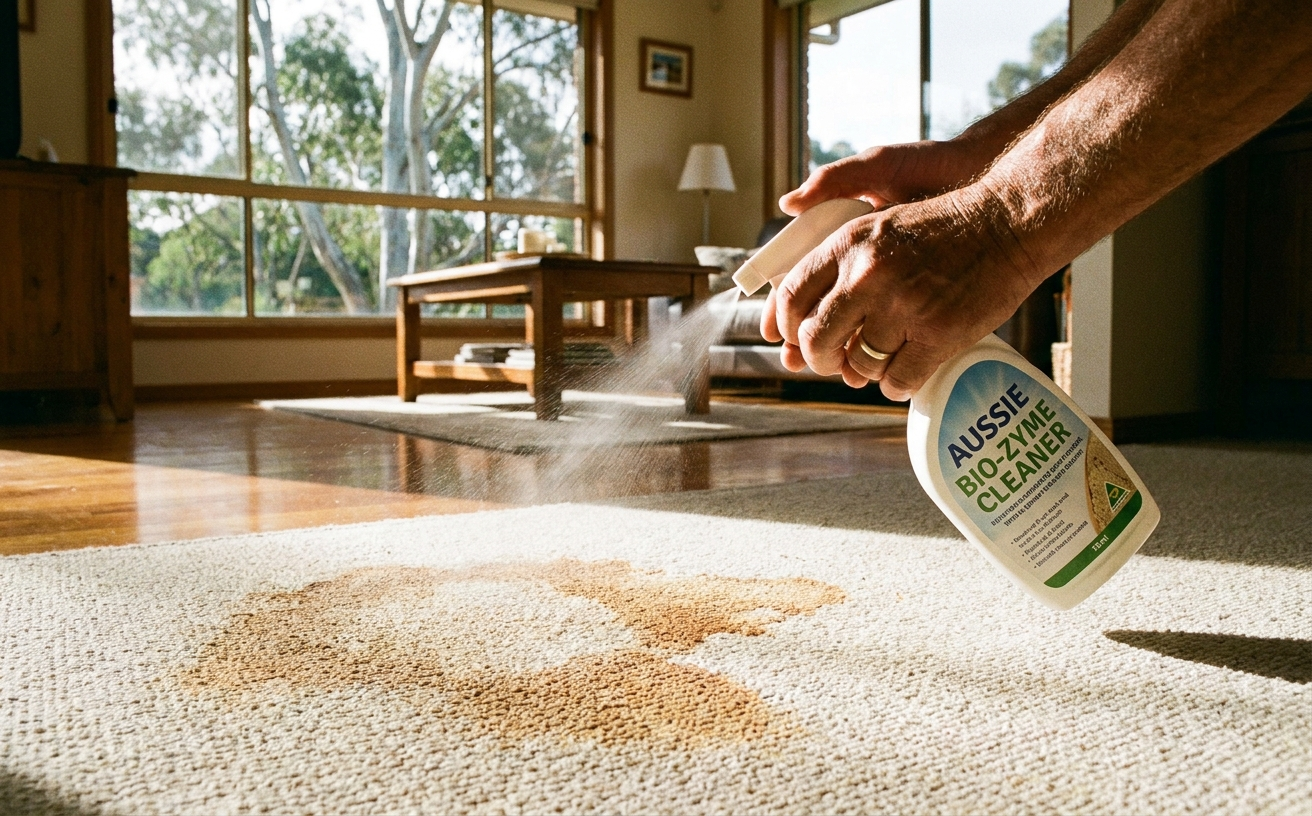
Apply enzyme cleaner generously — it needs to reach the same depth the urine penetrated.
Step 3: Blot Again and Allow to Air Dry
After the enzyme cleaner has had time to work, blot the area again with clean cloths. Then let it air dry completely. Do not use a heater or hair dryer on high heat, as heat can set any remaining residue into the fibres.
Step 4: Apply Bicarbonate of Soda for Odour Absorption
Once the area is mostly dry, sprinkle a generous layer of bicarbonate of soda over it. Leave it for at least 20 minutes, or overnight for stronger odours. Bicarbonate of soda neutralises residual acidity and absorbs moisture still trapped in the fibres. Vacuum thoroughly once dry.
Step 5: Treat Stubborn Stains with Hydrogen Peroxide
For stains that still show discolouration or odour after enzyme treatment, mix half a cup of 3% hydrogen peroxide with one teaspoon of dishwashing liquid. Apply to the area, let it sit for 20 minutes, then blot clean and rinse with cold water. Test this on an inconspicuous area first, as hydrogen peroxide can lighten some carpet colours.
How to Eliminate Dog Urine Smell from Other Surfaces
Different surfaces absorb urine differently, so the cleaning approach has to change with the material. Timber soaks liquid into the grain within minutes, tile holds odour mainly in the porous grout lines, and upholstery foam can trap urine well below the visible stain. The principles below apply enzyme cleaner where it is safe to use it and adapt the technique for materials where standard methods can cause damage.
Hardwood and Timber Floors
Urine on hardwood floors needs to be addressed immediately. If left for more than a few minutes, it can seep into the grain, causing permanent staining and warping. Blot the area dry as quickly as possible, then apply a small amount of enzyme cleaner diluted with water. Wipe dry promptly with a clean cloth. Never allow moisture to sit on timber flooring. For deep-set stains in older timber, light sanding followed by refinishing may be necessary.
Tile and Hard Floors
Tile and sealed hard floors are the easiest surfaces to treat. Wipe up the urine with paper towels, spray with a diluted enzyme cleaner or white vinegar solution, leave for a few minutes, then mop clean with cold water. Pay particular attention to grout lines, which are porous and can hold odour even after the tile surface looks clean. An old toothbrush with enzyme cleaner works well for scrubbing grout.
Upholstery and Sofas
Check the care label before applying any cleaning solution to upholstered furniture. For fabric upholstery, blot the urine immediately and apply enzyme cleaner, pressing it in with a clean cloth to penetrate the cushion foam. Allow to air dry in a well-ventilated area. For leather or synthetic leather, use only diluted enzyme cleaner or a mixture of water and a small amount of white vinegar, as hydrogen peroxide can damage some materials.
Mattresses
A mattress accident requires fast action. Blot up as much liquid as possible, then saturate the area with enzyme cleaner and cover with a dry towel. Press down firmly to help the cleaner penetrate the mattress foam. Leave for 15 minutes, then blot again and allow to air dry completely before remaking the bed. This can take several hours. Bicarbonate of soda applied after drying helps absorb any remaining odour. Never sleep on a damp mattress, as this creates ideal conditions for mould and bacterial growth.
Clothing and Washable Fabrics
Add half a cup of white vinegar to the wash cycle along with your regular detergent, and select a cold wash setting. Hot water sets the odour into fabric. For heavily soiled items, pre-soak in an enzyme cleaner solution for 30 minutes before washing. Air dry in sunlight where possible, as UV light has a natural deodorising effect.
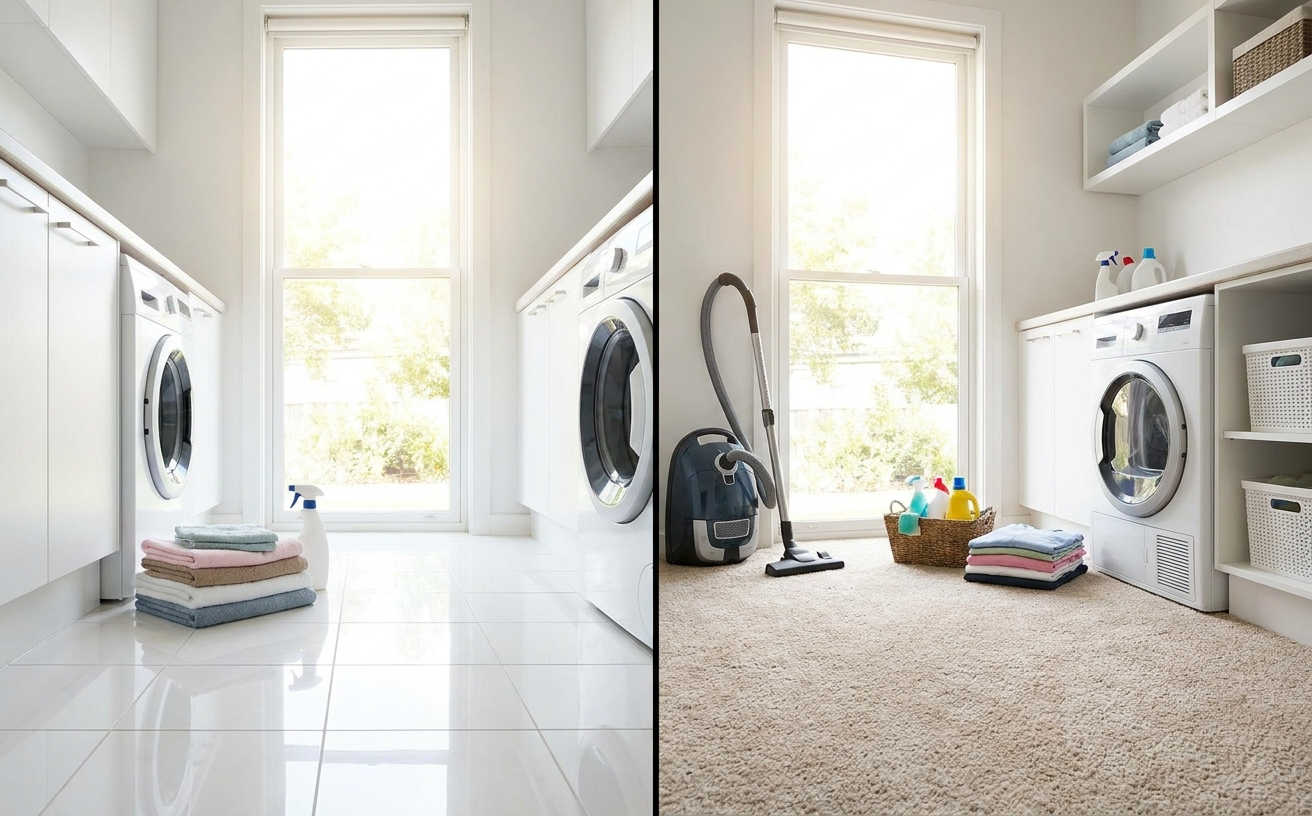
Different surfaces need different approaches — grout lines on tile and carpet backing both trap uric acid crystals.
How to Find and Treat Old, Dried Dog Urine Stains
Dried urine stains are invisible in normal light but become clearly visible under a UV blacklight torch. Turn off the lights in the room and scan the floor and upholstery slowly. Urine stains will glow yellow-green. Mark each spot with a small piece of chalk or tape before turning the lights back on.
Rehydrating Dried Urine
Dry uric acid crystals need to be reactivated before they can be broken down. Lightly spray the marked area with warm (not hot) water to loosen the crystals, then apply enzyme cleaner as you would for a fresh stain. Allow significantly more dwell time for old stains — up to 30 minutes — and repeat the treatment if the odour persists after drying.
When to Call a Professional
If urine has saturated through carpet underlay and reached the subfloor, home treatment may not be sufficient. In this case, the underlay likely needs to be removed and replaced, and the subfloor may need sealing with an odour-blocking primer before new underlay is laid. A professional carpet cleaner with a truck-mounted extraction system can also achieve a deeper clean than most domestic equipment.
How to Stop Your Dog from Returning to the Same Spot
Fully eliminating the odour is the most important preventive step. Once the area is treated and dry, keep your dog away for at least 48 hours while the surface airs out completely.
Commercial dog repellent sprays applied after cleaning can discourage remarking. Some pet owners find that placing your dog's food bowl near the previously soiled area also helps, as dogs generally avoid toileting near their feeding spots. Consistent toilet training and keeping a close eye on your dog indoors are the most reliable long-term prevention strategies.
Beyond the surface itself, lingering particles from urine and pet dander can stay airborne for hours after cleaning. If anyone in your household reacts to pet allergens, a vacuum with a sealed HEPA filter for pet allergens traps the fine dander and bacterial particles that conventional vacuums can recirculate into the air during cleaning.
Acting Fast on Hard Floors: The First Few Minutes Matter Most
On timber and tile, the window between accident and damage is short. Urine that sits for more than a few minutes seeps into wood grain and grout lines, where enzyme treatment becomes harder and surface damage may already be done. Removing the liquid completely in the first pass — before reaching for the enzyme cleaner — is what makes the difference between a clean recovery and a permanent stain.
A wet-dry vacuum is built for this. The Narwal S30 Pro cordless wet and dry vacuum delivers 20,000 Pa of suction, which lifts liquid out of the surface rather than just spreading it across the floor. While vacuuming, the head continuously rinses with fresh water from a separate tank — so the floor is never wiped with the same dirty water it just picked up. For an accident on hardwood or tile, this means the urine is physically removed in the first minute, after which enzyme cleaner can be applied to the now-clean surface to break down any residue that penetrated the grain or grout.
FAQs
Does white vinegar actually kill dog urine smell?
White vinegar neutralises the ammonia component of dog urine and reduces odour noticeably for fresh stains. However, it does not break down uric acid crystals, which are the primary source of persistent smell. For stains that have dried or that keep returning, an enzyme-based cleaner is more effective.
How long should I leave vinegar on the carpet for dog urine?
Five to ten minutes is enough for vinegar to neutralise surface ammonia. Leaving it longer does not improve results, because vinegar cannot break down the uric acid crystals deeper in the carpet. After the contact time, blot thoroughly and follow with bicarbonate of soda, or apply enzyme cleaner if the odour returns once the carpet is dry.
Why does my carpet still smell like dog urine after cleaning?
The most common reason is that the urine penetrated deeper than the cleaning solution reached. Carpet fibres, backing, and underlay can all absorb urine, and if only the surface is treated, uric acid crystals remain in the lower layers. Saturating the area with enzyme cleaner — enough to reach the same depth the urine did — and allowing sufficient dwell time usually resolves this.
Is baking soda enough to remove dog urine odour?
Bicarbonate of soda absorbs and neutralises surface odours effectively, but it does not break down uric acid. It works best as a final step after an enzyme cleaner has already treated the stain. Used alone on a fresh or dried urine spot, it will reduce but not eliminate the smell.
Can I use a steam cleaner on a dog urine stain?
Steam cleaning is useful for general deep cleaning of carpet, but applying heat to an untreated urine stain can permanently set the odour by bonding the proteins in urine to the fibres. Always treat with enzyme cleaner first and allow the area to dry before any heat-based cleaning.
Does dog urine smell ever fully go away?
Yes, with the right method. Enzyme-based cleaners break down uric acid crystals into smaller compounds that evaporate, eliminating the source of the odour rather than masking it. Without enzyme treatment, the smell can persist for months or years because the crystals stay dormant until reactivated by humidity or moisture.
Does dog urine smell worse when it rains or is humid?
Yes. Uric acid crystals reabsorb moisture from the air, which reactivates the odour. This is why areas that seemed clean can smell strongly again on humid days. It is a reliable sign that the crystals were not fully broken down and the area needs re-treatment with enzyme cleaner.

