
A bagless vacuum cleaner in use on hardwood floors
A bagless vacuum cleaner collects dust and debris in a reusable canister rather than a disposable bag, using cyclonic airflow to separate particles before they reach the filter. For most Australian households, this means no ongoing bag costs, a clearer picture of when to empty, and consistent suction right up until the canister is full.
How a Bagless Vacuum Cleaner Works
The core mechanism is cyclonic separation. When air and debris enter the vacuum, they’re spun at high speed inside a cylindrical chamber. Centrifugal force throws heavier particles outward, and they drop into the collection canister while cleaner air continues through to the filter. This process means suction stays relatively stable as long as the canister isn’t overfilled and the filter is clean, because there’s no bag to gradually restrict airflow.
Most modern bagless vacuums use multiple cyclone stages to catch progressively finer particles before they reach the filter. The filter’s job is to capture what the cyclones miss, including fine dust, pollen, and pet dander. This is why filter condition matters so much: a clogged filter creates the suction loss that bagless designs are built to avoid.

How cyclonic separation works inside a bagless vacuum canister
Bagged vs Bagless Vacuums: Key Differences
Both types clean effectively. The differences that matter are in running costs, how you handle dust during emptying, and how suction behaves over time.
Running costs
Bagless models eliminate ongoing bag purchases entirely. Bagged vacuums typically require replacement bags every few weeks depending on usage, which adds up over years of ownership. Bagless vacuums do require periodic filter replacement (typically every six to twelve months), but this cost is usually lower than maintaining a steady supply of bags.
Allergy and dust management
Bagged vacuums have an advantage here. The bag acts as a secondary filter, and when it’s full, you seal and dispose of it without touching the contents. Emptying a bagless canister releases a puff of fine dust, which can be a real concern for allergy sufferers or people with asthma. If this is a priority, look for a bagless model with a HEPA-rated filter and empty the canister outdoors or over a lined bin.
Suction consistency
A bagged vacuum loses suction gradually as the bag fills, because airflow through the bag fabric decreases over time. Bagless vacuums maintain more consistent suction until the canister reaches its maximum fill line, but they’ll also drop suddenly if the filter is overdue for a clean. Neither type outperforms the other automatically: maintenance habits matter more than the design.
Convenience
Bagless canisters are see-through on most models, so you can tell at a glance when it needs emptying. You can also see what you’ve picked up, which is useful for confirming you’ve got a particularly messy area clean. Bagged vacuums are simpler to empty when the bag is full, but require you to have replacement bags on hand, which not everyone keeps stocked.
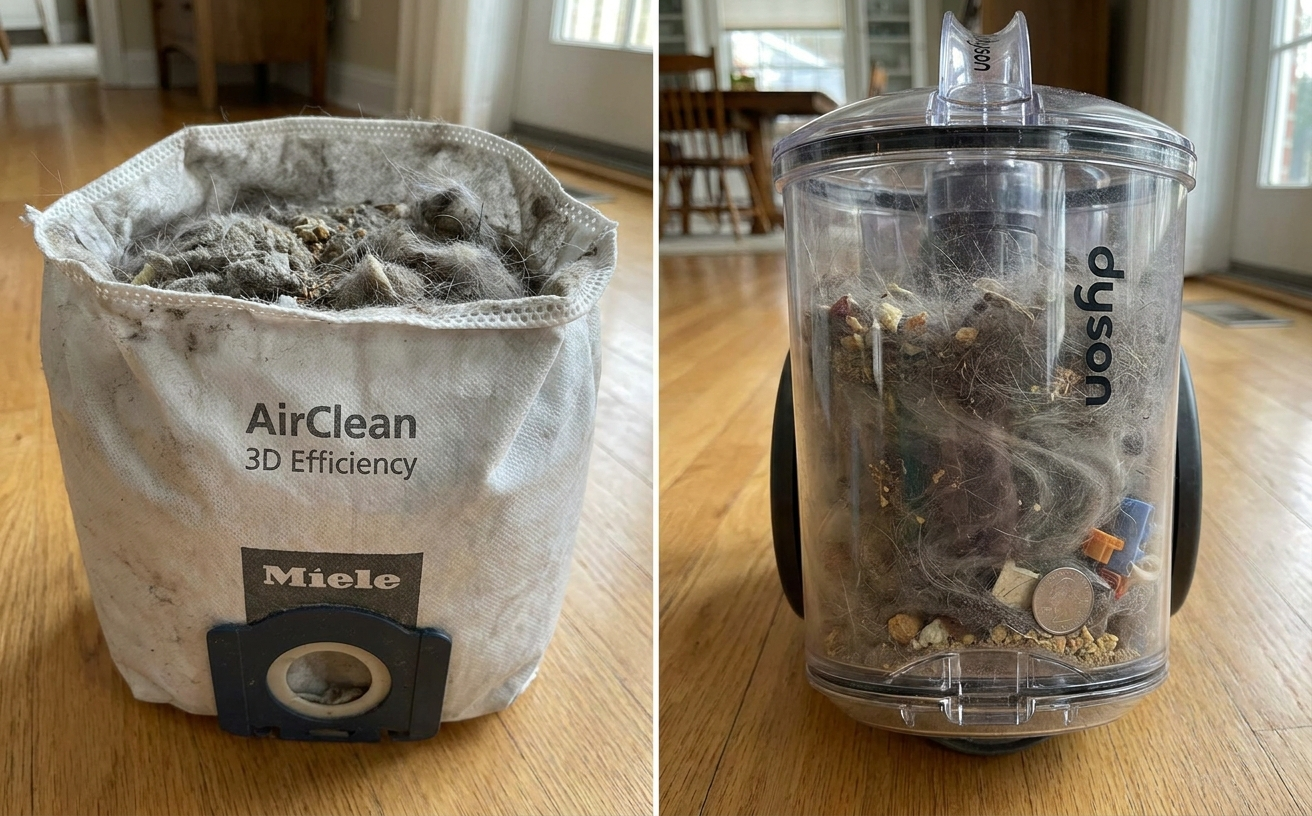
Bagged vs bagless: how debris is collected and stored
Common Types of Bagless Vacuum Cleaners
Bagless vacuums come in three main form factors. Each suits a different home layout and cleaning habit, and the right choice affects how useful the vacuum actually is day to day.

The three most common bagless vacuum types: barrel, upright, and stick
Barrel (cylinder) vacuums
Barrel vacuums have the motor and canister in a wheeled unit that trails behind you as you clean, connected to a wand and floor head via a flexible hose. They’re versatile across floor types, good at getting into corners and along skirting boards, and the canister size is generally larger than stick models. Most come with multiple attachments for above-floor cleaning, which makes them practical in larger homes.
Upright vacuums
Upright bagless vacuums have the motor, brush roll, and canister in a single unit you push across the floor. They cover large carpeted areas efficiently and typically have wider cleaning paths than barrel or stick models. They’re heavier to manoeuvre around furniture and harder to use on stairs, so they work best in homes with open floor plans and significant carpet.
Stick vacuums
Stick vacuums are slim, lightweight, and mostly cordless, which makes them the easiest type to grab for a quick clean. They store compactly and work well in apartments or homes with predominantly hard floors. The trade-off is a smaller dust canister (meaning more frequent emptying) and a battery that limits run time to anywhere from twenty to sixty minutes depending on the model and power setting.
The main limitation of most stick vacuums is that they only handle dry debris — spills and wet messes need a separate mop. The Narwal S30 Pro is a cordless wet and dry vacuum that removes this constraint: 20,000 Pa suction combined with 20N of downward pressure handles wet spills, pet mess, and everyday dry debris in the same pass, with a built-in scissors-and-comb system that cuts and clears tangled hair rather than letting it accumulate on the roller. For a home that deals with both types of mess regularly, that means one tool instead of two.
[cta:narwal-s30-pro-wet-dry-vacuums]
Features to Look for in a Bagless Vacuum
Within the same form factor, these are the features that create the biggest difference in real-world performance and how much upkeep the vacuum needs.
HEPA filtration
A HEPA-rated filter captures particles down to 0.3 microns, including pollen, fine dust, and pet dander. This matters most if anyone in your household has allergies, asthma, or respiratory sensitivities. Not all bagless vacuums include HEPA filters as standard, so check the specification rather than assuming.
Washable filters
Washable filters reduce ongoing costs and make maintenance easier. The important thing is to let them dry completely before re-inserting, typically around 24 hours, because a damp filter restricts airflow and can cause suction loss.
Floor type adjustment
Vacuums with adjustable floor settings, or automatic floor detection, handle the switch between hard floors and carpet without you needing to manually change attachments. On hard floors, a motorised brush roll at full speed can scatter debris rather than pick it up; having the option to reduce or turn off the brush roll makes a practical difference.
Canister capacity and emptying mechanism
Larger canisters mean less frequent emptying, which is worth prioritising if you have pets or a large home. A bottom-release emptying mechanism (where you press a button and the bottom of the canister opens over the bin) is generally cleaner than pulling the canister off and tipping it manually.
Brush roll design for pet hair and long fibres
Traditional brush rolls tangle with long hair and pet fur, which requires regular manual clearing to maintain performance. Some models now use tapered or anti-tangle brush roll designs that direct hair into the canister rather than winding it around the roller. If pet hair or long hair is a recurring issue in your home, this feature is worth prioritising over other specs.
Is a Bagless Vacuum Right for Your Home?
Bagless vacuums work well in most Australian homes, but a few household factors make them a particularly strong fit.
- Primarily hard floors: Bagless stick and barrel models perform very well on tiles and floorboards, which are common in Australian homes.
- Pets or heavy shedding: Bagless models let you see how much pet hair you’ve collected and empty quickly when needed. Pairing with an anti-tangle brush roll significantly reduces maintenance time.
- Budget-conscious households: Eliminating bag costs over two to five years adds up. The main ongoing expense is filter replacement, which is generally less frequent.
- Allergy sufferers who empty carefully: A HEPA filter and mindful emptying technique (outdoors, into a lined bin, with a face covering if needed) makes bagless vacuums workable for most allergy households. For severe sensitivities, bagged vacuums still offer a cleaner disposal experience.
Maintaining a Bagless Vacuum Cleaner
The most common reason a bagless vacuum loses suction is deferred maintenance.
Empty the canister regularly
Most manufacturers recommend emptying after each use, or at minimum before the debris reaches the maximum fill line. When the canister is too full, fine dust gets pushed back through the cyclone and onto the filter, accelerating clog buildup and reducing suction.
Clean filters monthly
Monthly cleaning is a reasonable baseline for average use, though households with pets, children, or allergy concerns may need to clean filters more frequently. Tap off loose dust, rinse under cold water if the filter is washable, and allow a full 24 hours to dry. Running a vacuum with a wet filter restricts airflow and can damage the motor over time.
Replace filters every six to twelve months
Washing restores a filter’s performance, but not indefinitely. Filter material degrades over time, and a filter that’s been cleaned repeatedly will eventually stop capturing fine particles effectively even when it looks relatively clean. Replacing on a schedule (rather than waiting until suction drops noticeably) keeps the vacuum performing consistently.
Check for blockages
If suction drops suddenly after you’ve just cleaned or replaced the filter, a blockage in the hose, wand, or floor head is the most likely cause. Check each section separately: remove the hose and test airflow directly at the canister inlet, then work outward. Large debris (a rubber band, a wad of tissue, a clump of pet hair) caught at a bend can reduce airflow significantly.
Keep the vacuum smelling fresh
Odours from a bagless vacuum usually come from three sources: trapped moisture in the filter, decomposing organic debris in the canister (food crumbs, pet dander, hair), or buildup inside the hose. Empty the canister after vacuuming anything wet or food-related rather than letting it sit between cleans, and rinse the canister with warm soapy water every few weeks if your model allows it. Make sure the canister is fully dry before reattaching. If a smell persists after a clean canister and dry filter, the hose is the next place to check; running warm water through a detached hose and letting it dry overnight clears most lingering odours.
Store correctly
Keep bagless vacuums away from direct sunlight, extreme heat, and areas with high moisture. Storing in a laundry or outdoor shed in Australian summers can expose the motor and canister to temperatures that degrade plastic components and seals over time.

Washing a washable HEPA filter: allow 24 hours to dry before reinserting
FAQs
Are bagless vacuum cleaners better than bagged ones?
Neither is universally better. Bagless vacuums are more cost-effective over time and easier to monitor, but bagged models offer cleaner disposal and tend to suit allergy sufferers who want to avoid any dust exposure during emptying. The best choice depends on your household, floor types, and how much maintenance you’re willing to do.
Can I use a bagless vacuum if I have allergies?
Yes, with a few precautions. Choose a model with a HEPA-rated filter, empty the canister outdoors or over a lined bin, and consider wearing a face covering if you’re highly sensitive. Some allergy sufferers still prefer bagged vacuums for the sealed disposal.
Why has my bagless vacuum lost suction?
The three most common causes are a full canister, a clogged filter, or a blockage somewhere in the hose, wand, or floor head. Start by emptying the canister and checking the filter. If suction doesn’t improve, disconnect the hose from the canister and test airflow directly at the inlet to isolate where the restriction is.
What are common problems with bagless vacuums?
The most frequent issues are loss of suction (usually a full canister, dirty filter, or blockage), unpleasant odours from trapped debris or moisture, dust escaping during emptying, and brush rolls clogged with hair. Most are tied to maintenance frequency rather than product faults. Other recurring problems include cracked canister seals from rough handling, and reduced battery life on cordless stick models after a few years of regular use.


